
20.1 - When Absence Is Not the Only Thing We See
Based on John 20:1–10
It was still dark when Mary came to the tomb.
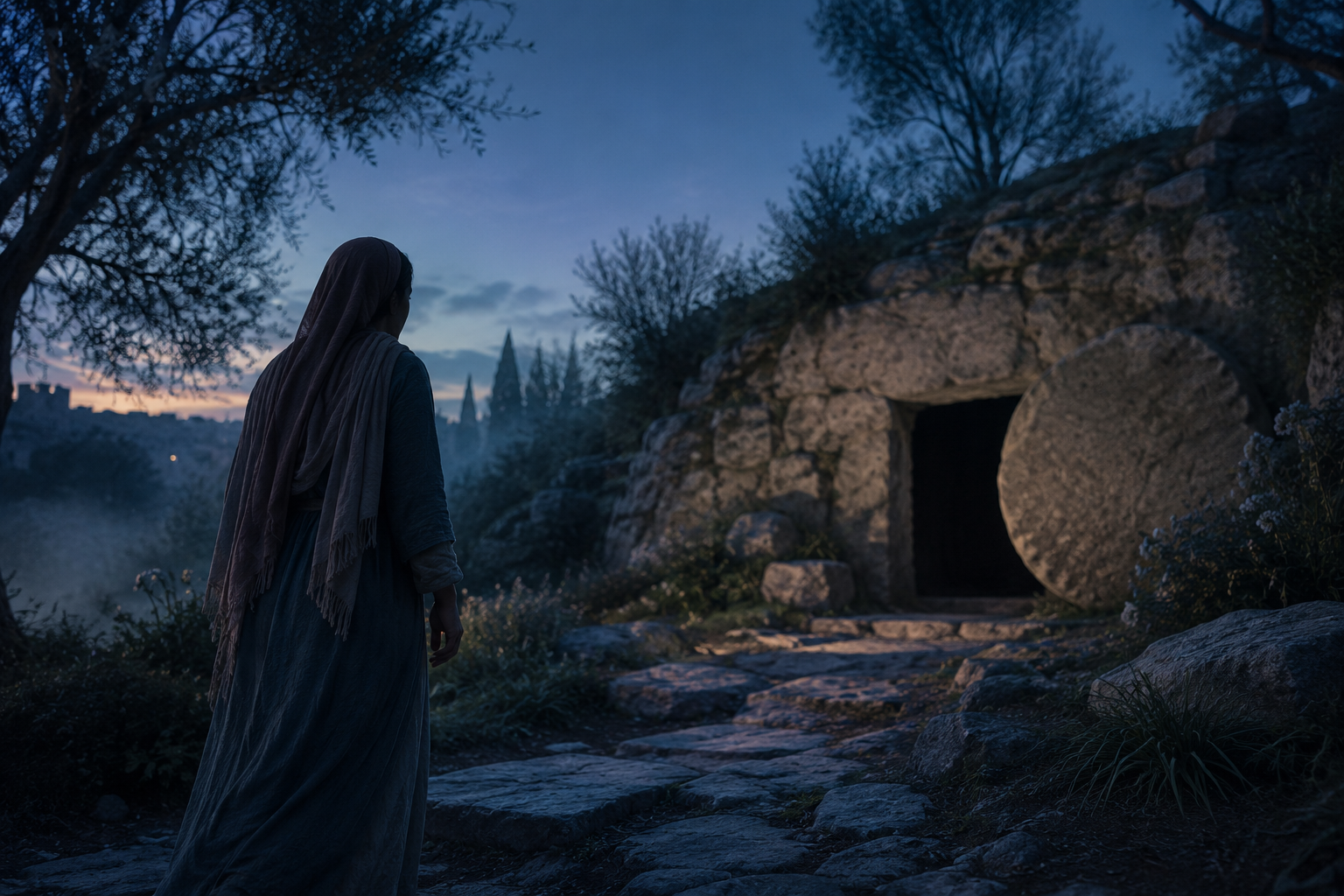
Mary comes while it is still dark, before grief has found words.
John does not waste words, so I do not think that detail is accidental. The darkness is not only in the sky. It is in the body, in the chest, in that strange hollow place where grief lives before language catches up. Mary comes while the world is still half-hidden, walking toward the place where they had laid him, because that is what grief often does. It sends us back to the last place we knew where to put our love.
The tomb is terrible, but at least it is a place. At least sorrow has an address.
I try to stand there with her before I explain her. Before I turn this scene into theology, before I talk about resurrection, before I draw meaning from the empty tomb, I need to feel the weight of that morning.
Then she sees the stone moved.
That is all it takes. Not a voice from heaven, not an angelic announcement, not a sudden burst of light, but simply the stone out of place. Suddenly, the small stability she had left gives way.
“They have taken the Lord out of the tomb, and we do not know where they have laid him” (20:2).
I do not hear that as unbelief. I hear it as panic. I hear the voice of someone whose grief has just been wounded again. First, they took his life. Now, she thinks, they have taken even the place where his body could be honored.
Mary sees through the eyes of love in shock.
That is one kind of seeing.
You and I may know something about that. Something happens, and before we understand it, we interpret it through fear. The doctor calls. The phone rings late. A relationship goes quiet. A door closes. A plan falls apart. We see the fact in front of us, but we do not yet see the whole truth. We see what grief permits us to see.
So Mary runs.
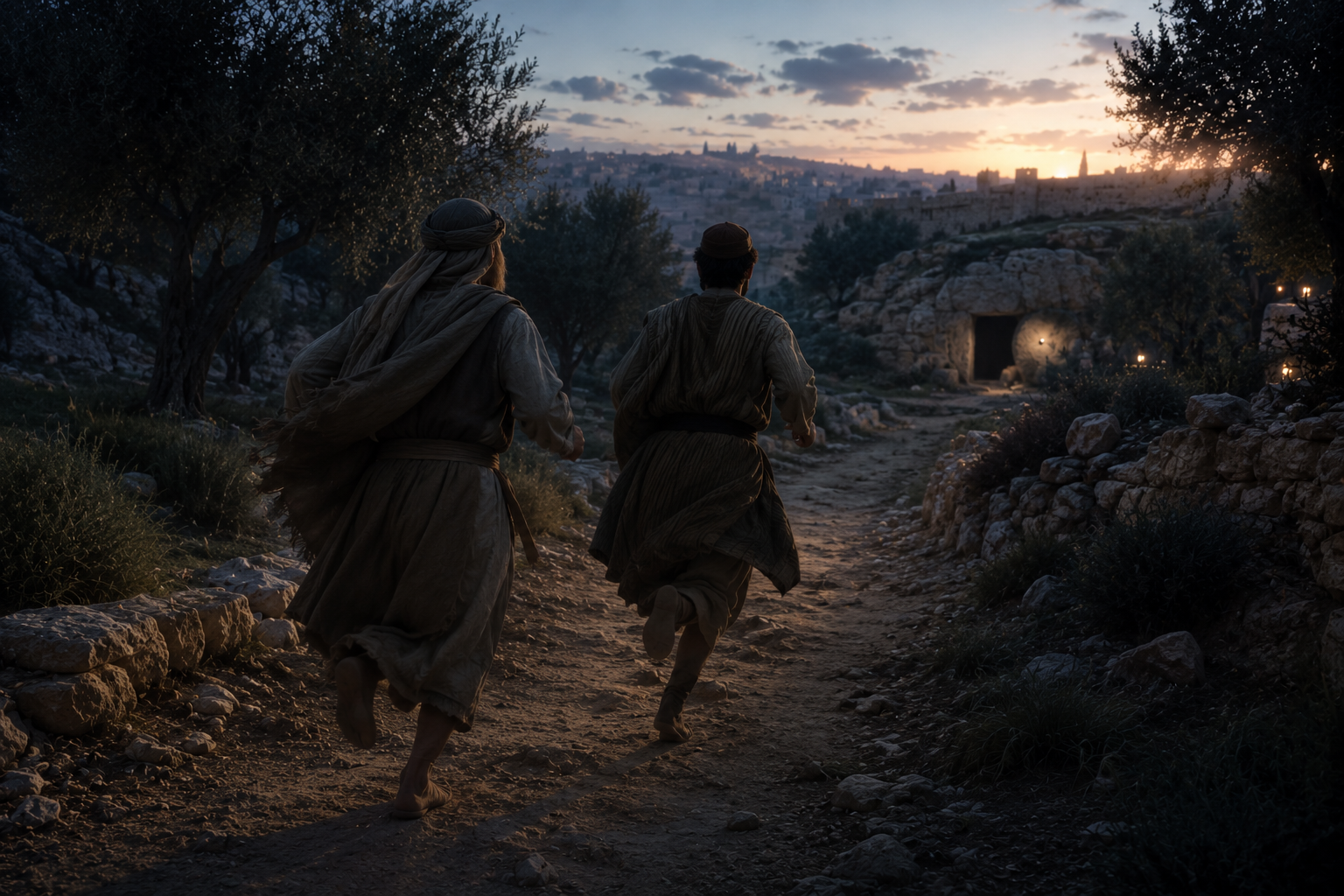
Nobody is walking calmly toward a doctrine. They are running toward an absence.
That detail feels deeply human. When pain becomes too much to hold alone, we go looking for someone else to carry part of it with us. Peter and the other disciple begin running too, and I can almost feel the uneven rhythm of it: breath, dust, confusion, urgency. The beloved disciple runs faster. Peter follows. Nobody is walking calmly toward a doctrine. Nobody is composing a creed. Nobody is preparing a sermon.
They are running toward an absence.
Three Ways of Seeing
The beloved disciple reaches the tomb first, but he does not go in. He bends down and sees the linen cloths lying there (20:5), and I wonder what held him at the entrance. Fear, maybe. Reverence. Shock. Or that strange hesitation we feel when we know one more step may change everything.
There are thresholds in life where the body stops before the mind can explain why. Hospital rooms. Funeral homes. Empty bedrooms. The chair where someone used to sit.
He looks in, but he waits.
Then Peter arrives, and Peter, of course, goes in. That sounds like Peter. The man who speaks before he understands. The man who steps onto water and then notices the wind. The man who drew a sword in the garden. The man who denied Jesus beside a charcoal fire. Peter enters the tomb carrying more than confusion. He carries memory, failure, and the bitter taste of what he said he would never do.
He sees the cloths. He sees the face covering rolled up in a place by itself (20:6–7). He studies the scene. This is not the seeing of panic. This is the seeing of someone trying to make the evidence behave.
Something has happened here, but what?
The body is gone. The cloths remain. The tomb is empty, but not chaotic. This does not look like grave robbery. It does not look like haste. It does not look like defeat either.
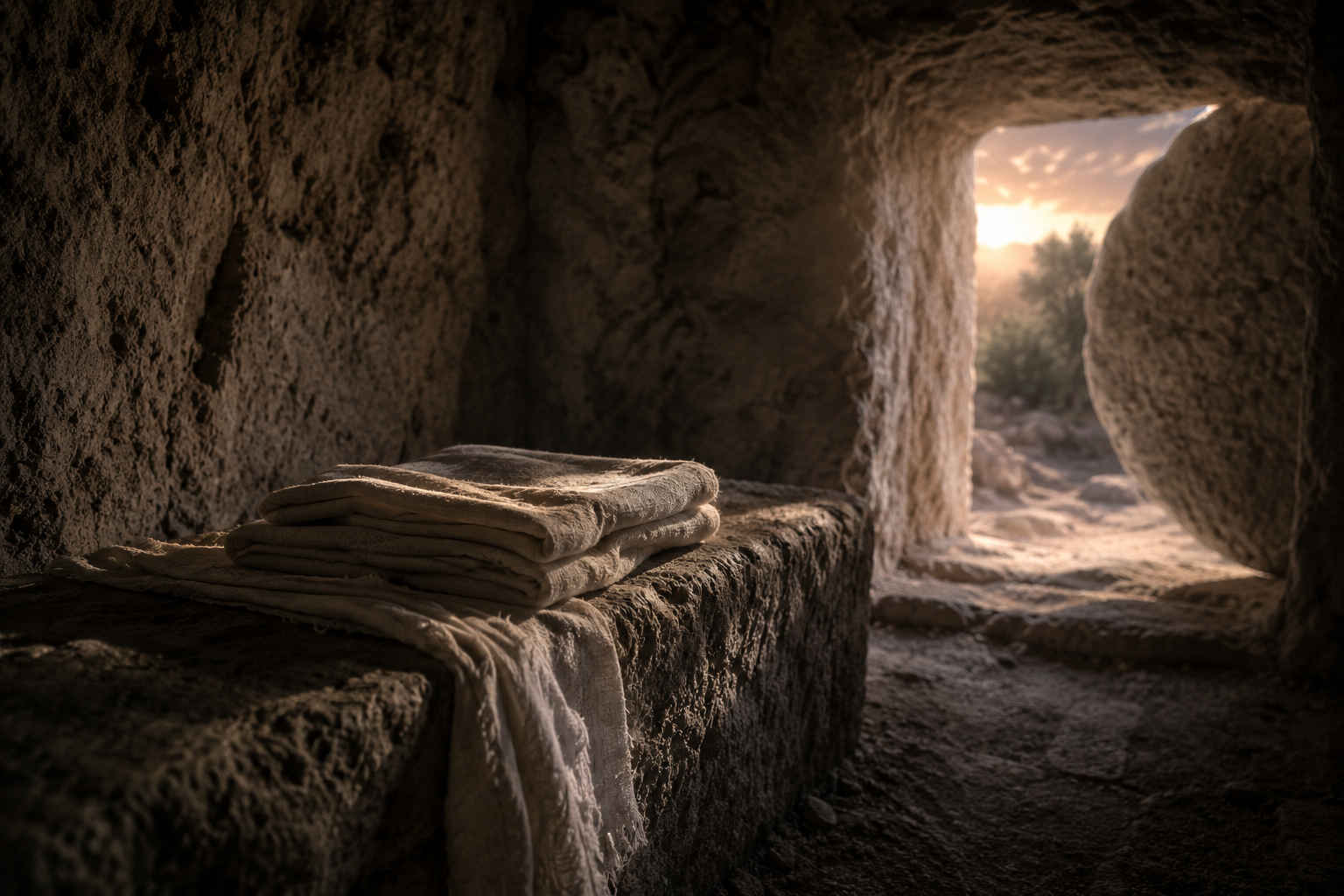
Peter sees carefully, but careful seeing does not always become faith immediately.
Peter sees carefully, but careful seeing does not always become faith immediately. Sometimes a person needs to stand inside the evidence for a while. Sometimes we need to look, and look again, before the deeper meaning begins to rise. That is not failure. That is how some hearts come awake.
Then the other disciple enters.
John says, “he saw and believed” (20:8). That sentence is so quiet I almost miss its power. His seeing seems different from Mary’s first alarm and Peter’s careful examination. It is not merely noticing the stone, and it is not merely studying the cloths. It is recognition. Something outside him meets something inside him. The empty tomb becomes more than an empty tomb.
Faith begins, though not full understanding. John is careful about that: “For as yet they did not understand the scripture, that he must rise from the dead” (20:9). That line matters because it reminds me that the beloved disciple believes before he can explain. He trusts before he can organize the theology.
That feels very close to life. Sometimes the deepest knowing comes before the words. We do not yet understand the event. We do not yet understand what God is doing. But something in us recognizes a truth before we can defend it.
That may be close to what I mean by deep life. Not escaping ordinary life, not floating above grief, not becoming more religious in a way that makes us less human, but living from the place beneath the first reaction, where love, memory, sorrow, and trust begin to speak together.
Mary sees and runs.
Peter sees and examines.
John sees and believes.
But I do not think John is ranking them. I think he is showing us the mercy of a journey. There are mornings when all we can do is see the stone moved and panic. There are seasons when we stand inside the tomb and study the cloths, trying to understand what has happened to our life. And then, sometimes, quietly and without fanfare, another kind of seeing opens.
The facts have not changed. The tomb is still empty. The loss is still real. But something deeper in us begins to perceive that God may be present even here.
Maybe especially here.
When I Saw Only Absence
This is where the scene reaches me personally, because I know something about seeing absence first.
When we lost Millie, at first that was almost all I could see: her absence, the empty space where her life should have kept unfolding, the terrible wrongness of it, the silence where there should have been laughter, birthdays, growing up, ordinary days, and years we thought were still ahead.
I could ask the questions, and I did ask them. Where was God in this? Why did this happen? How can a child be here, and then not be here?
There is no spiritual shortcut around that kind of seeing, and I do not want one.

The deeper seeing did not erase the empty place.
Even now, I can still see her absence. I can still look at the facts. I can still think about cancer as a random perversion of biology, cells turning against the very life they were meant to serve. That way of seeing matters because it keeps me honest. It keeps me from turning pain into poetry too quickly.
Some things should not be softened before they are faced. Some griefs should not be explained away. Some wounds should not be decorated with religious language just so we can feel better about them.
Millie was gone.
That remains true.
And yet, over time, another kind of seeing began to open, not instead of the first seeing, but alongside it, maybe beneath it. I began to see God’s movement in the people who moved toward Claire and Nick. Food was brought by hands that could not fix anything. Money was given quietly. Messages were sent. Condolences were offered. Friends, acquaintances, and even strangers stepped into the ache with whatever love they had to give.
None of it brought Millie back.
That has to be said plainly.
The deeper seeing did not erase the empty place, answer every question, or make the loss acceptable. But it did keep absence from having the only word. I began to see love moving through human beings, and as I saw that, my faith deepened. Not because I suddenly understood why Millie died. I did not. Not because grief became easy. It did not. But because I began to recognize that God’s presence often comes to us through embodied love: through people who show up, through mercy with a casserole dish, through compassion written in a check, through a note, a prayer, a hand on the shoulder, a silence shared.
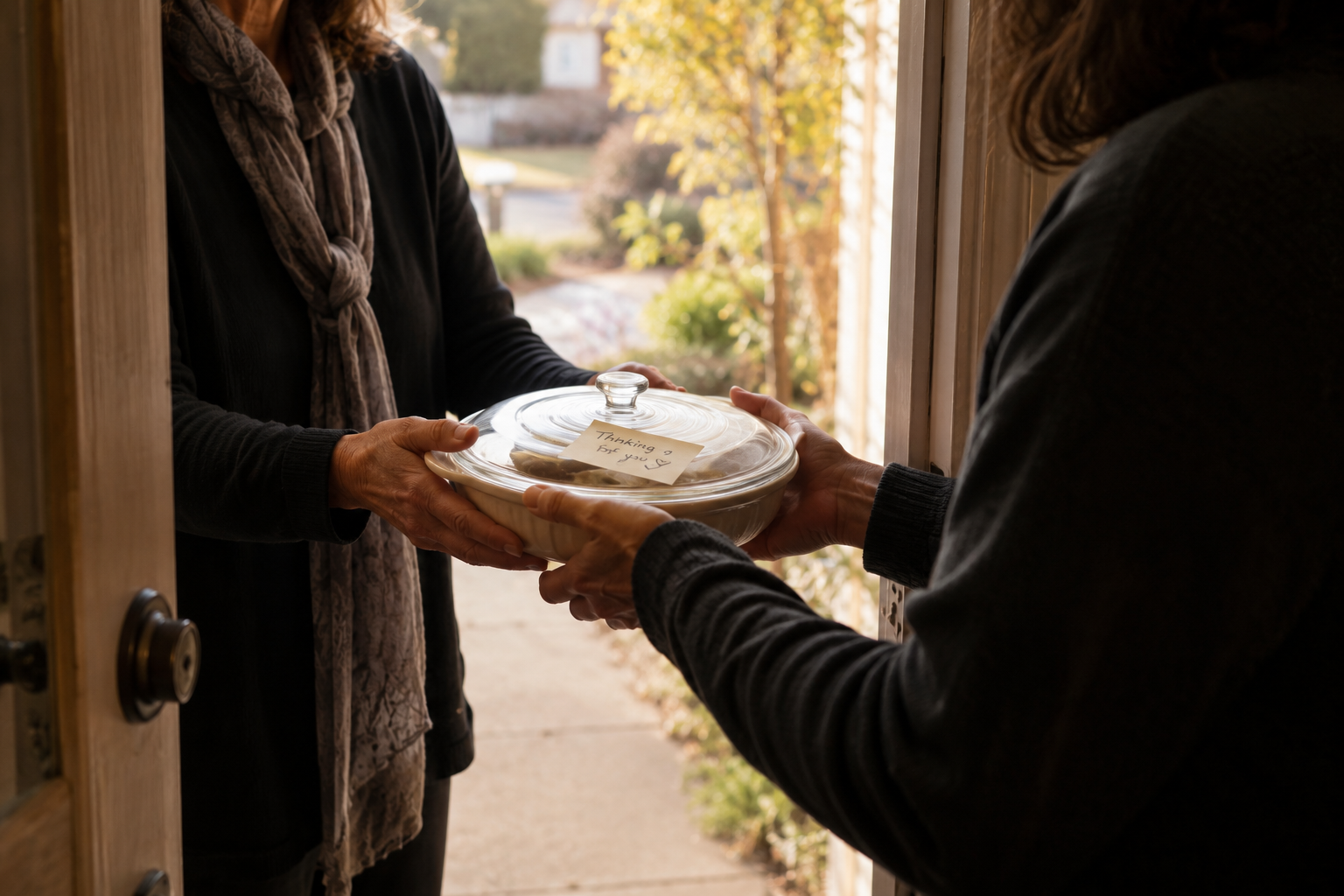
God’s presence often comes through embodied love.
That may be part of what John is showing me at the empty tomb. There is the seeing of absence. There is the seeing of evidence. And there is the deeper seeing that perceives love still moving.
The tomb remains empty.
The loss remains real.
But absence is not the only thing there.
When the Empty Place Is Not the Whole Story
This feels important to me because faith that cannot look honestly at absence is too fragile for real life, but grief that cannot see anything except absence may slowly close the soul. John seems to leave room for both. Mary sees what is missing. Peter studies what remains. The beloved disciple begins to trust that something more is happening than any of them can yet explain.
That is not a denial of the empty tomb. It is a deeper way of standing inside it.
I do not want to use resurrection as a quick answer to human sorrow. I do not want to turn Mary’s fear, Peter’s confusion, or John’s faith into a neat spiritual formula. Real life does not work that cleanly. Neither does real grief.
The beloved disciple “saw and believed” (20:8), but John immediately tells us that they still did not understand (20:9). That is such a gift. Faith can begin before understanding is complete. Trust can stir before the mind has caught up.
Deep life does not mean having all the answers. It means becoming open enough to see more than one layer of reality at the same time. I can see Millie’s absence. I can examine the biology. I can grieve the randomness and cruelty of cancer. And I can also see love moving through people.
One seeing does not cancel the other.
That is the honest place.
Perhaps that is where you and I live much of our lives. We stand between what is missing and what remains, between the stone that has been moved and the cloths that are still lying there, between fear and faith, between what we can explain and what we somehow begin to trust.
The disciple Jesus loved is the one who sees and believes first. Maybe John is telling us something about how perception is formed. Maybe we do not see deeply because we are smarter, faster, or more religious. Maybe we see deeply because love has been shaping us over time.
I wonder if love slowly trains the eyes.
I wonder if love helps us notice what fear misses, and remember what panic forgets. I wonder if love can stand before an empty place and, without explaining anything away, help us sense that this may not be the whole story.
I do not mean that love explains everything. It does not. But maybe love helps us remain open to what analysis alone cannot reach.
Mary’s seeing was not wrong. It was first. Peter’s seeing was not inadequate. It was careful. John’s seeing was not superior. It was awakened.
At least that is how I am beginning to hear this scene.
Maybe faith often begins this way, not with certainty shouted from a mountaintop, but with a quiet recognition in the dark. Something is gone. Something remains. And something may be being born that we do not yet understand.
Standing There Together
I wonder where you find yourself in this scene.
Maybe you are with Mary. You have seen the stone moved, and all you can feel is alarm. Something has changed. Someone is gone. A door has closed. A life you trusted has been interrupted. You are not ready for meaning. You are just trying to breathe.
Maybe you are with Peter. You have stepped inside the tomb and are looking around. You are trying to understand the facts. You are asking what happened, what failed, what could have been done, what comes next. You are not faithless. You are searching.
Maybe you are with the beloved disciple. You cannot explain everything, but something in you has begun to recognize that absence is not the only thing present. You have seen love move. You have seen kindness arrive. You have seen strength appear that you did not know you had. You have seen, not enough to explain, but enough to trust.
And maybe, on different days, you are all three.
I know I am.
Deep life may begin when we stop demanding that one kind of seeing erase the others. We do not have to pretend the stone was not moved. We do not have to stop asking questions. We do not have to call tragedy good. We do not have to turn grief into a lesson before grief has had time to speak.
But we can remain open: open to the possibility that love is still moving, open to the possibility that God is not absent simply because we first encounter absence, open to the possibility that faith may begin, not as certainty, but as a deeper way of seeing.
John tells us that after this, the disciples returned to their homes (20:10), and that line almost surprises me. No public announcement yet. No bold proclamation. No great movement launched from the tomb. They return home carrying something they do not yet fully understand.
That too feels true. Sometimes the deepest moments do not immediately change the outer shape of our lives. We still go home. We still make coffee. We still answer messages. We still walk past the empty chair. We still carry grief in the body.
But something has begun.
A different seeing. A small flame of trust. A sense that the story is not finished, even though we cannot yet say how.
Mary will have her own encounter. Her seeing will deepen too. She will turn and hear her name. She will become the first witness to the risen Christ. So I do not want to leave her trapped in panic. John does not leave her there.
Our first seeing is not always our final seeing. At least, I hope that is true. I think I have seen enough in my own life to believe it may be.
The way we see in the first hour of grief is not the only way we will ever see. That does not mean the first seeing was false. Mary really did see the stone moved. Peter really did see the cloths lying there. I really did see Millie’s absence, and I still do.
But maybe God is patient with our eyes. Patient with our panic. Patient with our need to examine the cloths before we can trust anything deeper.
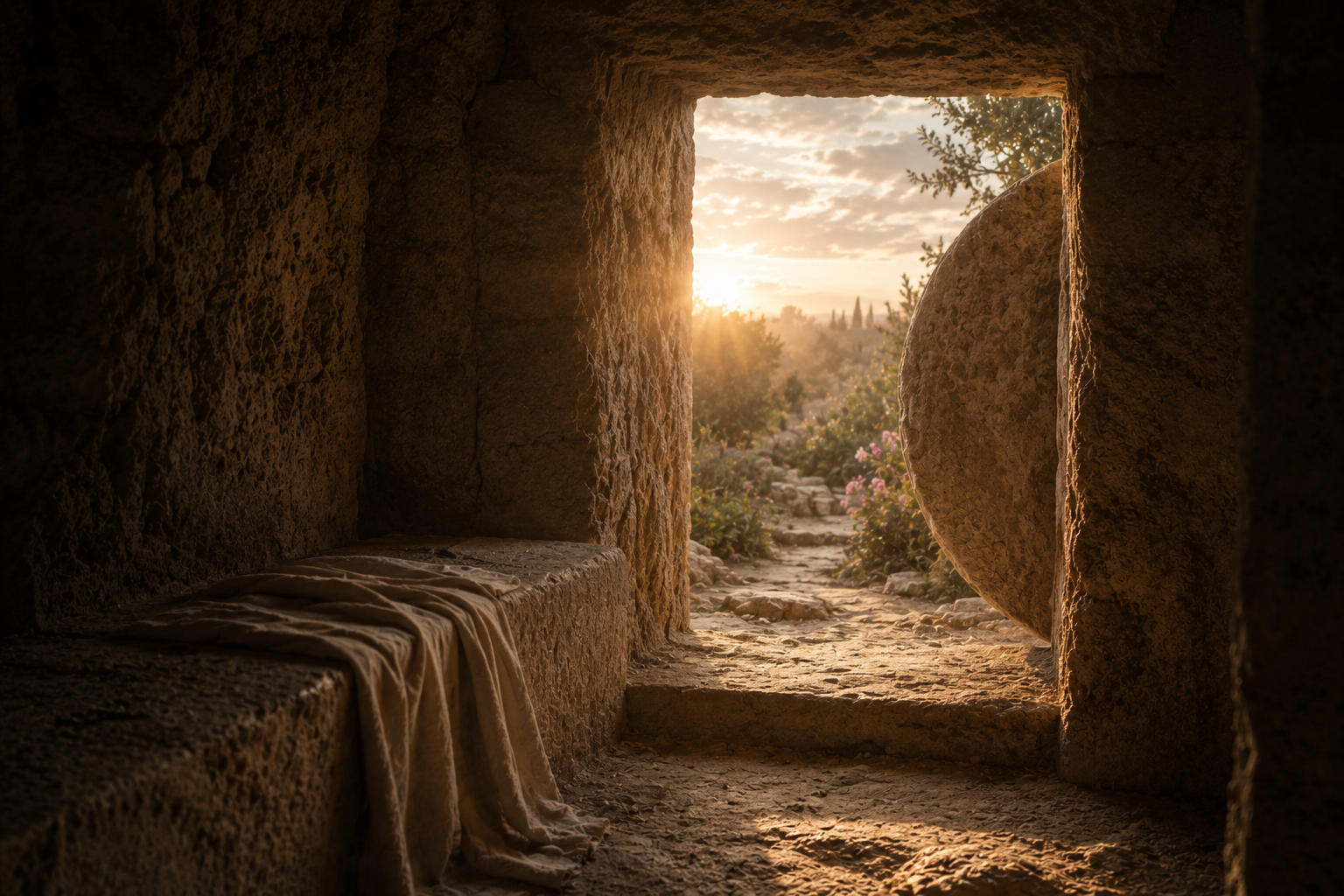
The first thing we see is not always the only thing there.
I find myself wondering if faith often begins quietly, not as certainty, not as an answer, not even as understanding, but as a small opening in us. A willingness to keep looking. A willingness to believe that the empty place may not be the whole story.
And sometimes, in the dark, near the place of absence, something in us begins to soften. We see what is gone. We see what remains. And maybe, if grace is given, we begin to sense that love is still moving.
We do not understand everything.
But we begin to trust.
And for some mornings, that is enough.
This is the glimpse I’ve been given, through John’s words and my own walk through loss and light.
Why Subscribe?
The John Project is my walk through the Gospel of John, one passage at a time, not as a lecture, but as a search. I am trying to listen for what these ancient words have to say about grief, love, faith, presence, and the ordinary places where life still asks us to pay attention.
If this reflection helped you see something in your own life a little differently, I invite you to subscribe and keep walking with me.
I would love to hear your thoughts.
Have you ever experienced a time when absence was real, but over time, you began to see something else moving there too? Not an answer. Not an explanation. But maybe love, presence, kindness, or grace.
