
19.2 — The Message in Motion
Based on John 19:16–30
The Moment Turns
I am going to be sick.
That was my first thought, not noble or spiritual, just the body reacting before the mind could catch up. One moment, there was still a sense that something might change. The next, it was already decided.
Around me, I could feel it in others too, that same collapse rising in their chests, the instinct to fall, to stop what was unfolding.
But there was no pause.
The machinery had already begun to move.
Routine Takes Over
The soldiers worked with a kind of practiced ease, their motions efficient, almost indifferent, as if this moment belonged less to tragedy than to routine. A crossbeam was brought forward. Rope followed. One of them began preparing the sign, shaping each letter with care, exactly as it had been ordered.
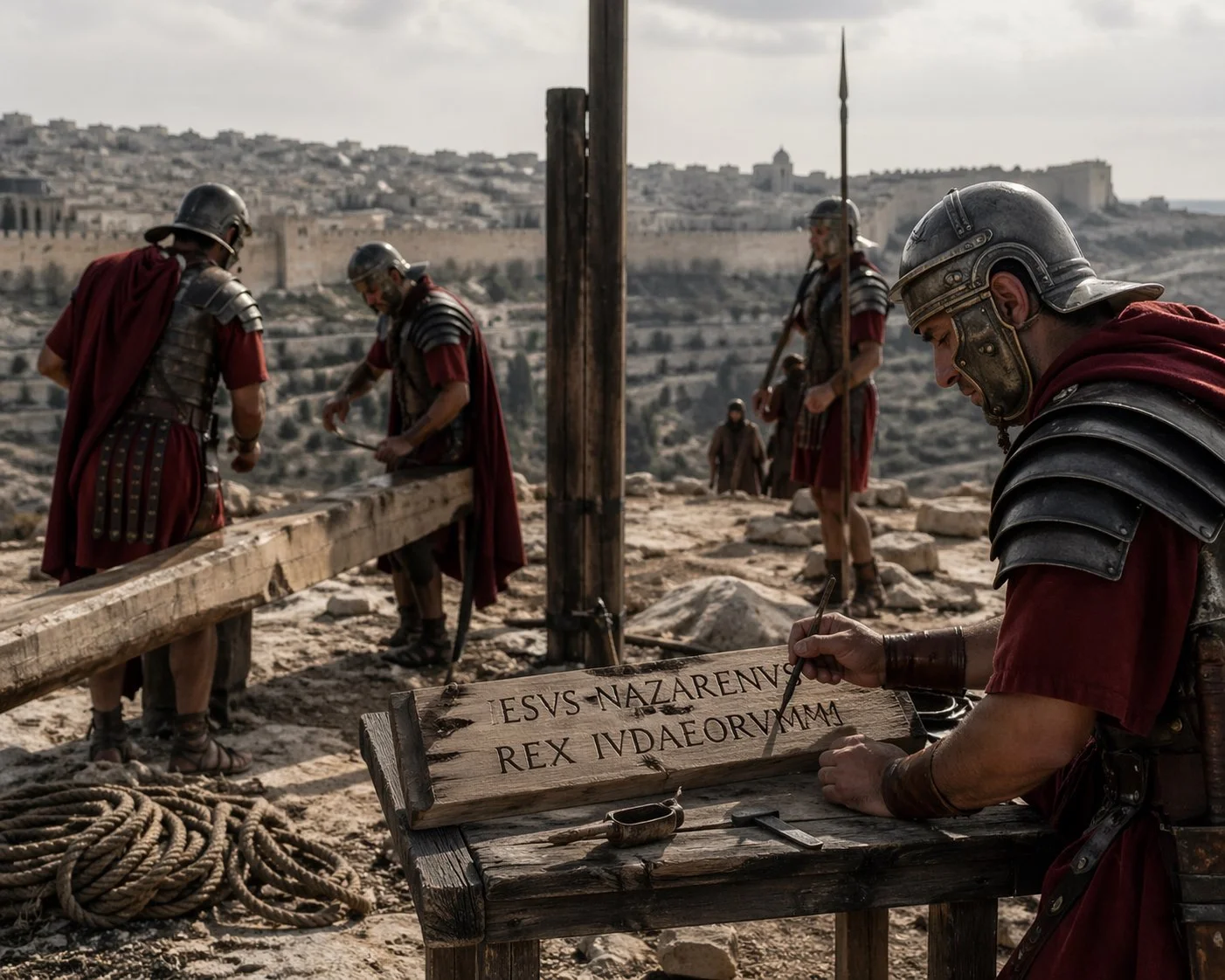
They moved with the ease of men who had done this before.
Not cruel. Not hurried. Just practiced.
As if even this could become routine.
And still, it moved forward.
I wanted to say something, anything.
“Wait.”
But the word never made it past my throat. And even if it had, it would not have mattered. The unthinkable was underway, and any chance to interrupt was already behind us.
A Message in Motion
A small group of soldiers stepped aside to confer, not about whether this should happen, but about how it would be seen. They were deciding the route, not the shortest path, but the most visible one, the one that would carry the weight of this moment through as many eyes as possible.
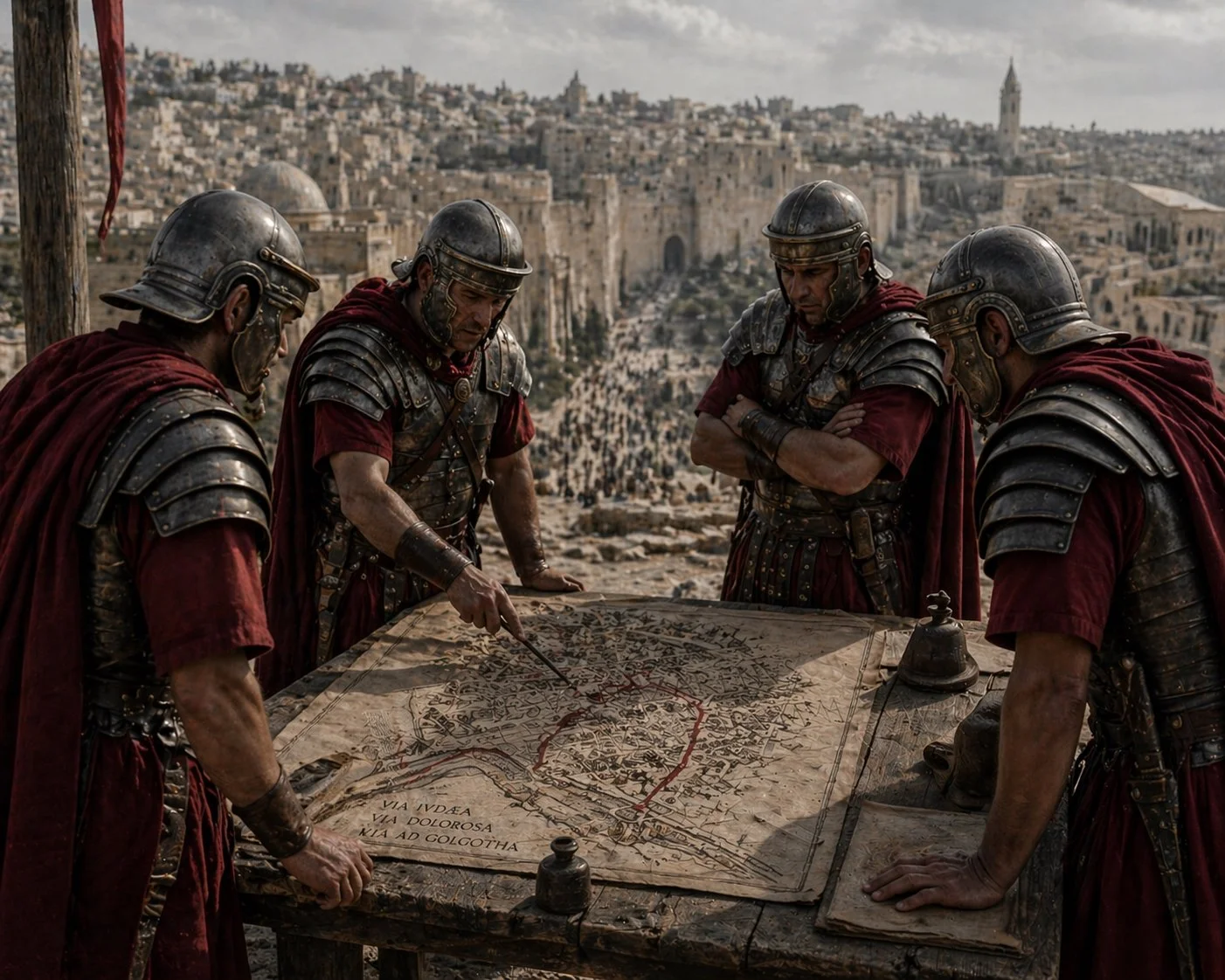
They weren’t deciding if it would happen.
Only how it would be seen.
Some roads carry more than distance. They carry a message.
And still, it moved forward.
Only then did it become clear.
This was not just an execution.
It was a message, carried forward in motion.
You could feel it move through the crowd as we began to follow, conversations fading, shoulders tightening, each person quietly measuring themselves against what they were witnessing.
No one said it out loud.
But everyone understood.
The World According to Power
As we passed beneath arches and along streets marked by Rome’s presence, the meaning pressed in without needing explanation. You didn’t have to think about Rome. You breathed it. Every arch, every stone, every guarded glance reminded you.
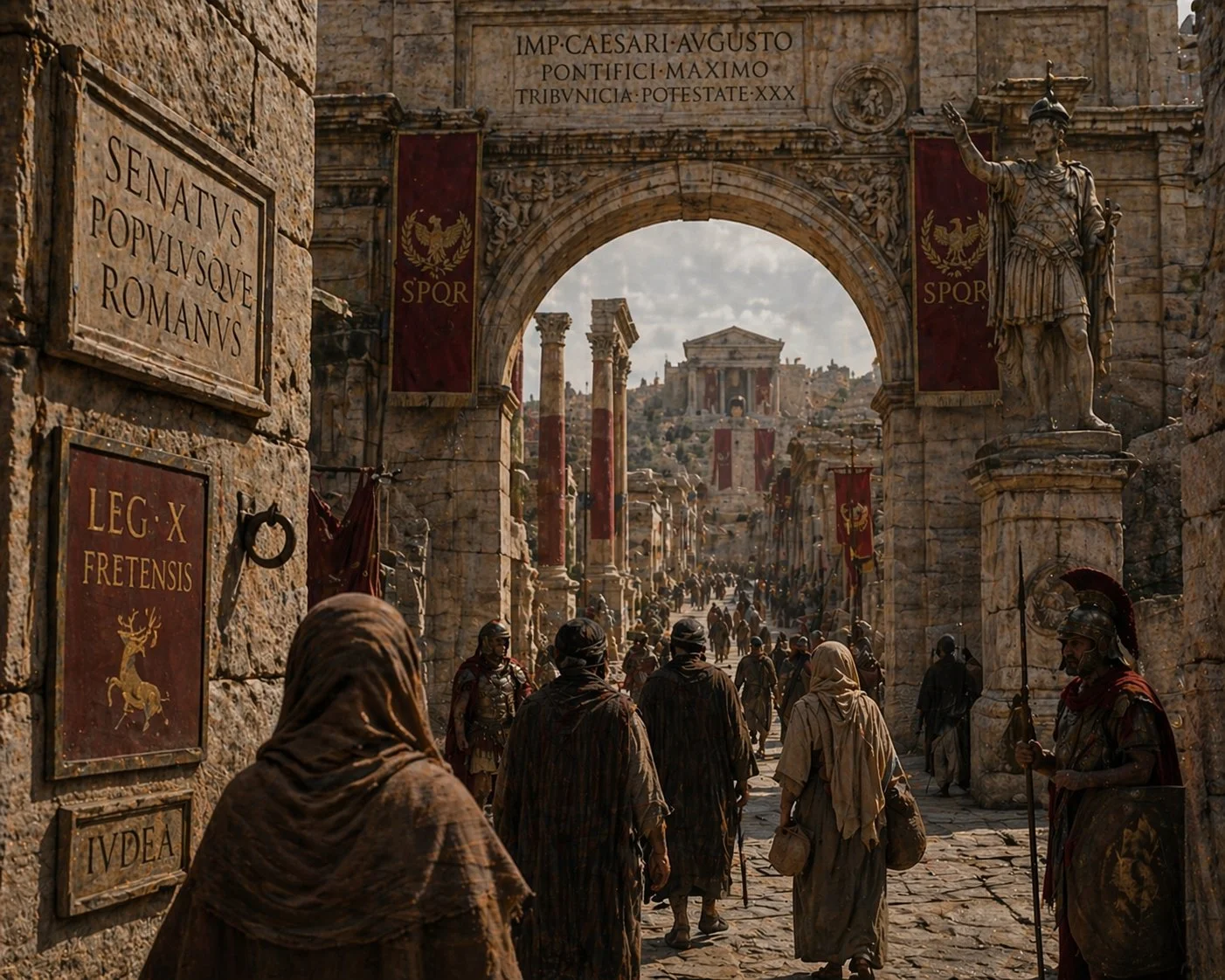
You didn’t have to think about Rome.
You breathed it.
It was in the stones, the arches, the silence between glances.
And still, it moved forward.
Then the hill came into view.
And with it, three crosses.
Not scattered, not incidental. Placed.
Arranged in a way that made interpretation unnecessary.
And there, at the center, raised slightly higher than the others, was the one for Jesus.
The sign above caught the light before anything else did: Jesus of Nazareth, King of the Jews.
People didn’t look at him first. They read the sign.
I had heard there was disagreement about the wording, that it had been challenged and resisted, but in the end, it remained exactly as Pilate had written.
Fixed.
Deliberate.
Nothing about this scene felt accidental. Not the placement. Not the sign. Not the robe or the crown pressed into his head. Pain alone would have been enough to end a life.
But this was doing something more.
Before you saw the man, you saw what they wanted you to believe about him.
The Urge to Take Control
Standing there, I felt something rise in me, sudden, urgent, almost overwhelming.
Stop this.
Do something.
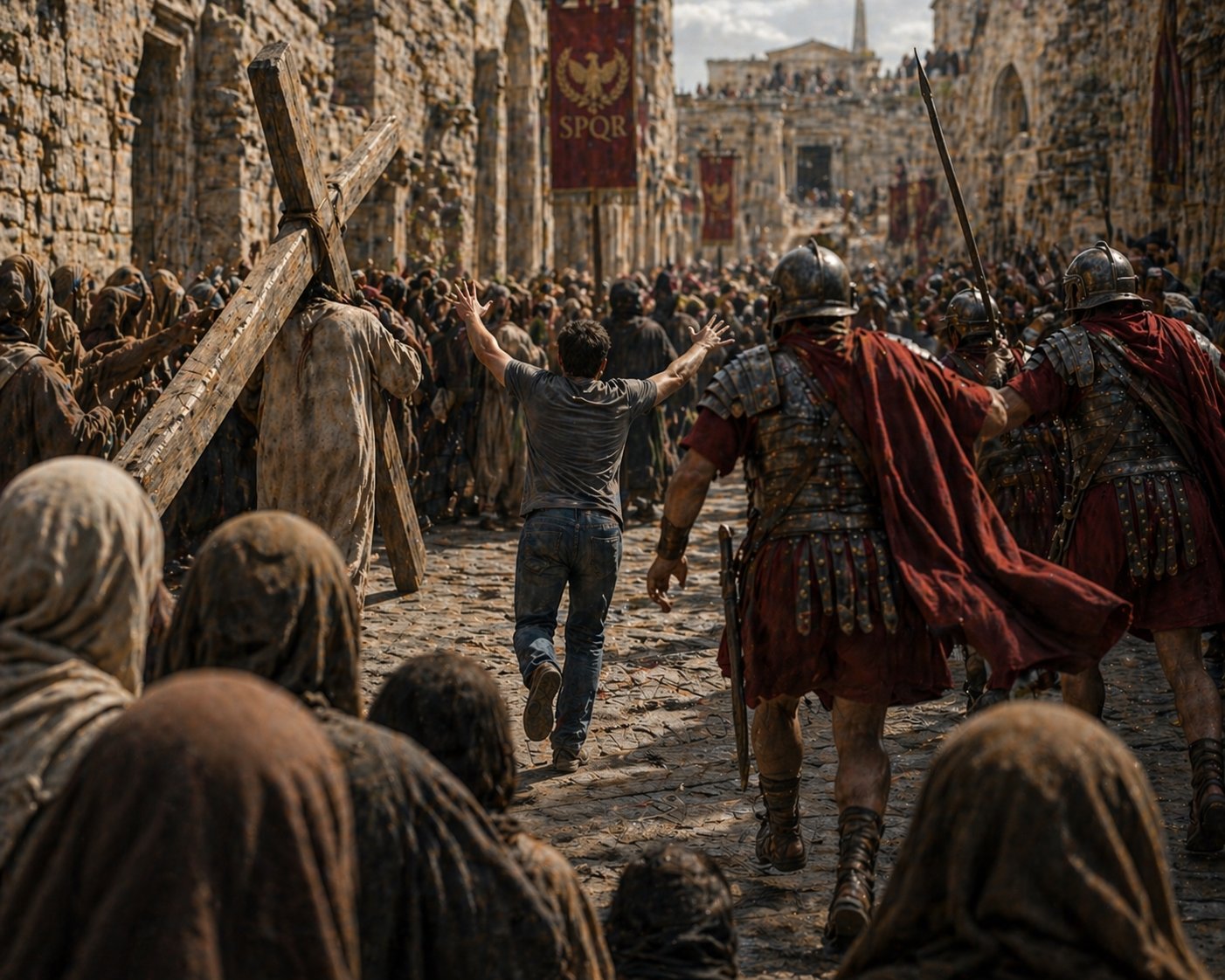
Part of me wants to run into the story.
To stop it. To change it.
But the story keeps moving.
And still, it moved forward.
It came with a clarity that, at first, felt like courage. Like the response a faithful person should have. To step forward, to intervene, to refuse what was unfolding.
But just beneath it, there was something else.
A need to seize the moment.
To force a different outcome.
And I could not ignore how familiar that feeling was.
I had called it faith before.
I had said it was conviction.
I had never questioned it.
A Different Kind of Power
As the procession slowed and the work continued, another awareness began to surface, quieter, but no less steady.
Jesus was not resisting.
There was no argument in him, no visible attempt to alter what was happening or to reclaim control of it. And yet, nothing about him felt diminished.
If anything, the opposite.
The attention of the crowd, the focus of the soldiers, even the uneasy watchfulness of those in authority seemed, in some way I could not fully explain, to gather around him.
Not demanded.
Drawn.
It did not look like power as I had understood it.
It felt more like presence, something steady enough that you didn’t look away.
Peace That Holds
Step by step, he moved within what was unfolding, without dividing himself against it. There was no trace of panic, no scrambling for another path, no visible fracture between what he faced and how he met it.
And in that, something unexpected began to take shape.
Peace.
Not the kind that comes from escape, from winning, or from bending events to your will. This was something quieter, more grounded, something that held even here, where nothing was being held back.
My mind drifted gently to earlier moments I had heard about, to the waters of the Jordan, to the voice that named him an accepted and beloved son, and to the long stretch in the wilderness where other tempting paths had been offered, but he accepted his own.
At the time, those moments had seemed separate, almost isolated.
Now they felt connected.
As if they had been forming something all along.
And here, at the end, that something was not breaking under pressure; it was being revealed.
Care in the Middle of It All
Even then, in the middle of it all, his attention turned outward.
He saw his mother.
He saw the one standing beside her.
And he spoke, not about the pain, not about the injustice, but about her care, about what would come next for her.
It was such a small thing, and yet it carried a weight that did not belong to the moment. As if what was happening to him had not closed him off but somehow left him fully present within it.
It Is Finished
“It is finished.”
The words did not rise so much as settle, like something gently set down after being carried a long way.
For a while, I didn’t move.
The sounds around me continued, the shifting of the crowd, the low voices, the dull rhythm of activity, but they seemed distant, as if something closer had gone quiet.
The Crown
And then my eyes found the crown.
It had shifted slightly, no longer pressed as tightly as before. Twisted branches, thorns still dark in places where they had done their work.
It looked almost ordinary.
Like something taken from the edge of a field and hurriedly shaped into what it needed to be.
I couldn’t look away.
Not because of what it symbolized, or what it had been meant to say, but because he had received it.
Not chosen it.
Not reshaped it.
Received it.
And something in that unsettled me.
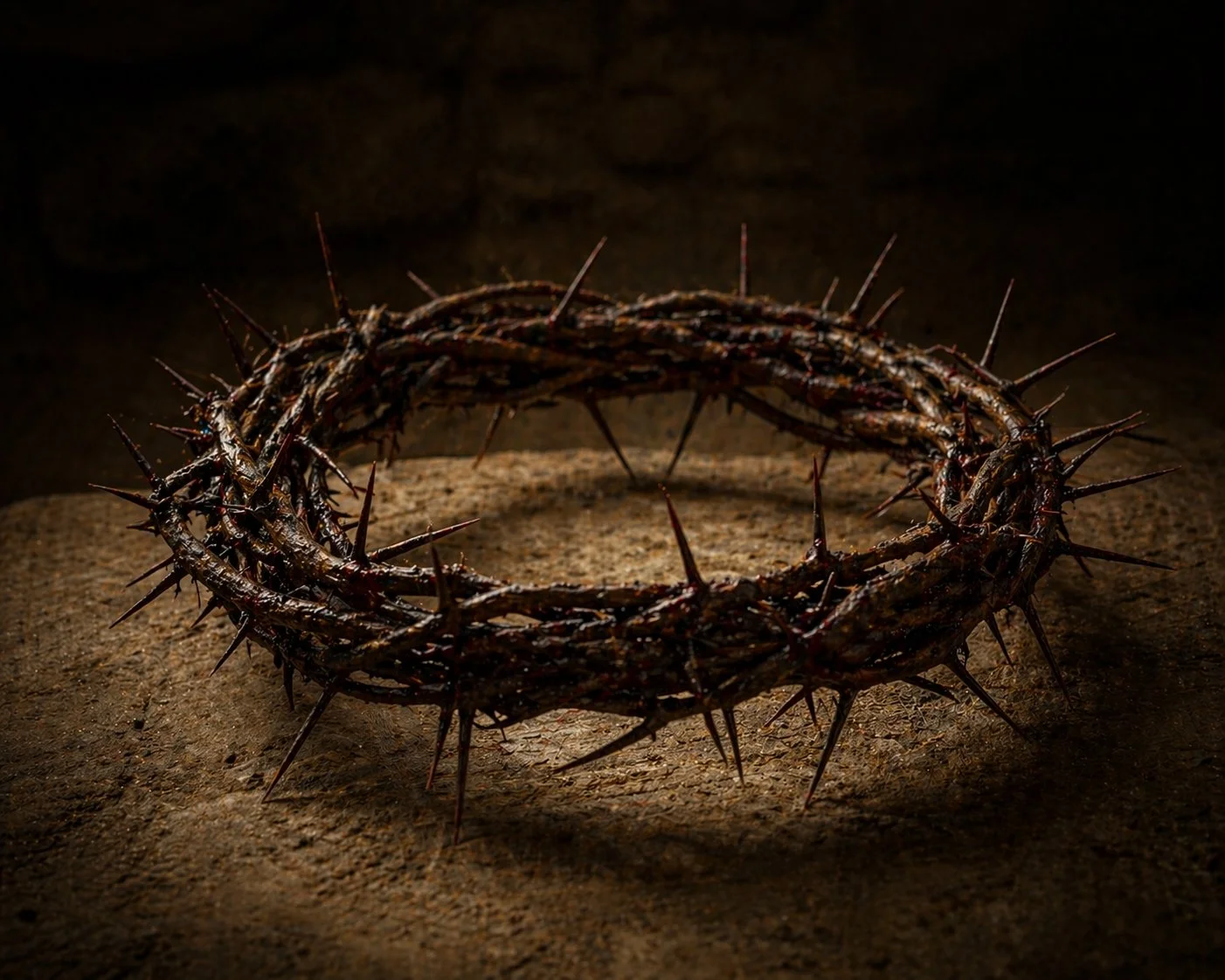
It looks almost ordinary.
Like something gathered without thought.
Until you notice what it was made to do.
And still, it moves forward.
The Question That Remains
I became aware, almost all at once, of how much effort I carried, how often I resisted what was not my idea, and how quickly I reached for something I could direct and control.
I had mistaken that reaching for something faithful.
My gaze lingered on the crown.
And the question did not arrive all at once, or in clear words.
It unfolded slowly.
What would it mean to trust that I am already accepted, not in theory, but enough to stop reaching for something other than what is?
To live what has been given, instead of standing just outside it,
trying to adjust it into something else?
I’m not sure when it became more than a thought.
Or when it turned into something I couldn’t easily step away from.
But somewhere between looking at that crown
and standing in the quiet that followed,
it settled.
Not as an answer.
Not even as a conclusion.
But as something waiting to be lived.
The crowd had already begun to move.
After a moment,
I did too.
To my Grandchildren and their Children:
You may be trying to control what needs to be received.
What holds your attention reveals what holds power over you.
Presence can draw more deeply than force ever will.
Acceptance is not weakness; it is alignment.
Your role isn’t something you invent; it’s something you step into.
