
18.4 — The Fire and the Question
Click here to Subscribe and receive a new copy in your inbox when available.
Based on John 18:12–27
Stepping Inside the Scene

John tells the story of Jesus sometimes quickly, sometimes agonizingly slow—but always in a way that invites us inside the scene. We watch him come up out of the water at the hands of the baptizer and wonder, "Who is this man?" We are Nicodemus asking, "How can a man be born again?" We are the woman at the well asking, "You aren't the Messiah, are you?" We are on the mount listening to a sermon, and later in the crowd gathering baskets of leftover fish and bread. We are the adulterous woman caught in the act, the man born blind, Martha and Mary at their brother’s deathbed, wondering, "Where is he?" We are in the crowd outside the tomb as Lazarus comes forth. We've been at the supper, in the garden, and now face-to-face, with the highest authority in the known world.
In each scene, we've seen this Man live out his highest values, speak from his inner voice, and follow his path, taking each next step. By placing us in each scene, John has given us the opportunity to ask ourselves, "What would I have done?" And come face to face with our own inadequacy.
The Cup in His Hands
This is especially true in our next scene, where Jesus holds the cup he has been given to drink. John has us so close we can smell what's in the cup and know, "This is not good!"
We don't have to be clairvoyant to make such a prediction. No, just observant and intelligent enough to read the signs along the way.
By simply being who he was, Jesus had been quietly undermining the authority of the temple system all along. And now, he is standing, hands bound, in front of the patriarch of the temple system’s first family. For Annas, the man who controls the temple economy, Jesus was a direct threat to the entire system and its leadership.
The Courtyard and the Fire
And no sooner than our chest has tightened, and our pulse has quickened, John whisks us outside the room into the courtyard, searching for other disciples. Only two follow Jesus and the soldiers into the city. One of them is Peter, the rock, the man with the sword, and the part within each of us that wants to control every unpleasant situation. He was cold. He was afraid. But he was there, close enough to eavesdrop on the activity in the open courtroom just off the courtyard.

"Where would I be?” I ask myself. “Would I be standing around the fire next to Peter, or halfway back to Galilee with the other disciples?” So for now, let's assume we are with Peter. The slave girl asks, “You're not one of his disciples, are you?” We overhear Peter respond, “I am not,” and immediately think, Whew, I'm glad she didn't ask me.
Peter’s Identity Crisis
"I am not" sounds, at first, like denial. Perhaps, if we could hear the tone of his voice, they would also sound like the words of a man in the middle of an identity crisis.
Just three years earlier, he had been a struggling fisherman, a husband, and the son of Jonas. Then Jesus changed everything, calling him disciple, friend, even “Rock,” the foundation of his future church. For a while, those names gave Peter a clear place in the story.
But now the man who held that story together stands inside the house, bound and questioned. Peter is outside, far from home, standing around an unfriendly fire under the gaze of suspicious eyes. In a single evening, the future he had imagined has collapsed.
It's not a stretch to imagine him thinking, I'm not even sure who I am anymore.
“Identity confusion is not failure. It is part of being human.”
When the Mask Falls Away

Modern psychology has a name for moments like this. Carl Jung called it the persona, the social mask we wear in order to live among others. Roles are necessary. A fisherman fishes. A teacher teaches. A parent cares for children. But Jung warned that trouble begins when we confuse the mask with the person wearing it. When the role disappears, the self suddenly feels lost.
Standing beside that charcoal fire, Peter may be experiencing something every human being eventually faces. When the titles fall away, and the expectations collapse, we are forced to ask a quieter question: Who am I, really?
That question is not limited to apostles standing in ancient courtyards. It follows every one of us. Careers end. Children grow up. Positions change. The roles we carried for years slowly loosen their grip. If we have mistaken the role for the self, we suddenly feel the same emptiness Peter may have felt in that moment.
Standing in Our Own Transitions
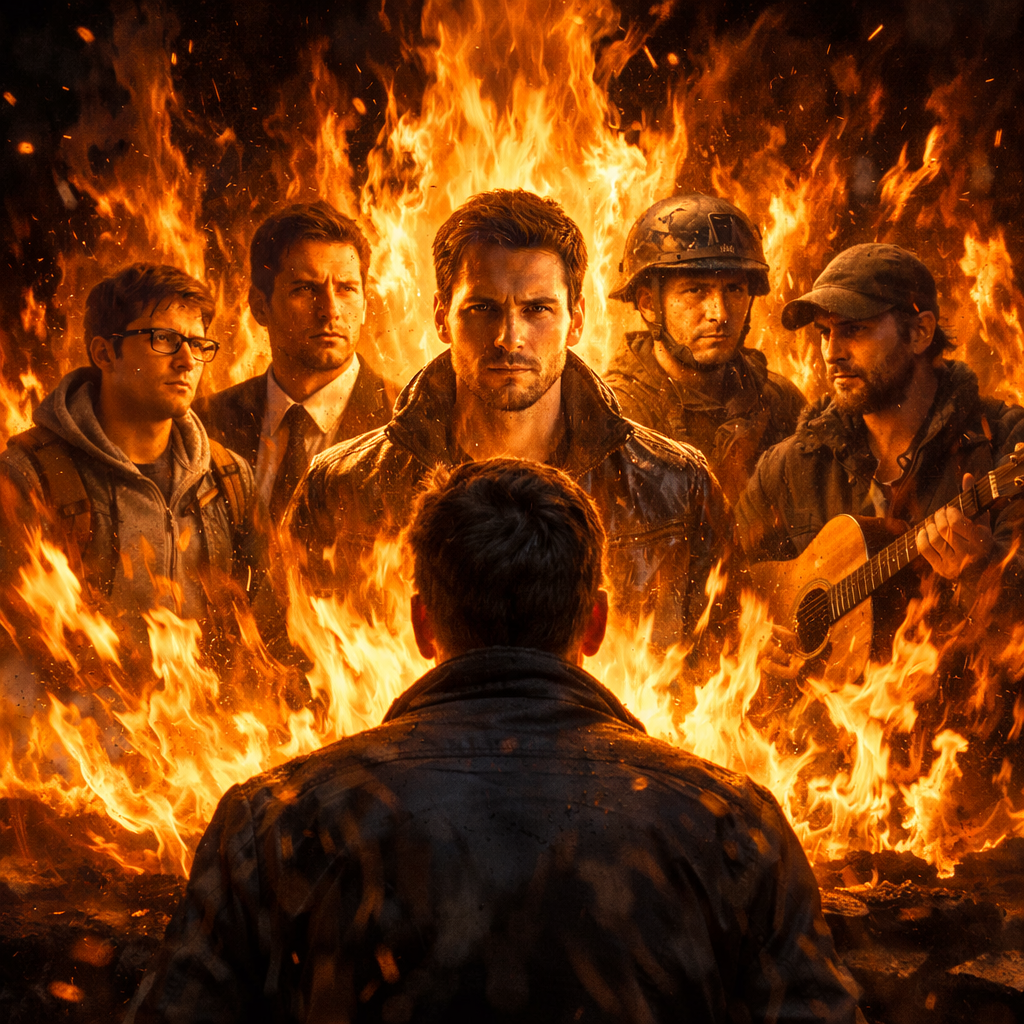
So perhaps we should give the fisherman a little slack and remember the transition points in our own lives. When children no longer need us in the same way. When clients and colleagues who once filled our days quietly disappear. When an untimely death reshapes the life we knew and the roles we carried for so long.
“Who am I now?” we find ourselves asking with Peter as we warm by the charcoal fire of uncertainty.
It is often in those dark and quiet moments that we begin to realize something important. Jesus knew those seasons would come. He even warned his friends about them. Yet he loved them anyway.
And perhaps it is right there, beside that fire of uncertainty, that the healing begins.
We begin to see that the roles we carry are important. But they are never the deepest truth about who we are.
“When the roles fall away, the real question finally has room to speak: Who am I, really?”
Back Inside the Room

But John doesn't let us stay by the fire. We join Jesus upstairs in the public room, while keenly aware that Peter is just over our shoulder down in the courtyard. We want to be in both places, but suddenly in walks Annas, and we freeze. He is the former high priest and father-in-law of the current high priest, who carries the full authority of the Temple. His authority has been handed to him, affirmed by the system, reinforced by Rome.
Our attention returns to Jesus, who stands before him.
From the moment he heard within himself, “You are my son, in whom I am well pleased,” he has moved through his life step by step, following that voice and remaining anchored to it. While everything around him now begins to tighten, there is no sense of urgency in him, no scrambling to adjust or defend.
The Question and the Blow
Annas begins his questioning. First, the disciples. Then the teaching. He is searching for something he can measure, something he can categorize, something that fits within the system he understands.
But Jesus does not adjust himself to meet those expectations. He stands, calm and steady, as if the answer to the question Annas is asking has already been settled somewhere deeper.
Jesus is given one opportunity to answer the man who holds authority over him.
“Question those who have heard me,” he says.
It is not the answer Annas is looking for. The response is taken as disrespect. A hand strikes his face, and he is sent on to Caiaphas.
The Fire Still Burning
“The fire is not just a place of exposure. It is a place of discovery.”
Back in the courtyard, around the fire with Peter, the questions continue.
“You're not one of his disciples, are you?”
“Didn’t I see you in the garden with him?”
“No.”
“No.”
The fire is still burning.
The questions are still coming.
And somewhere between the shadows and the first light of dawn, a rooster breaks the silence.
