
20.3 - Recognition, Receiving, and Responsibility
Based on John 20:11–31
Sometimes the deepest truths are not discovered through argument but through recognition.
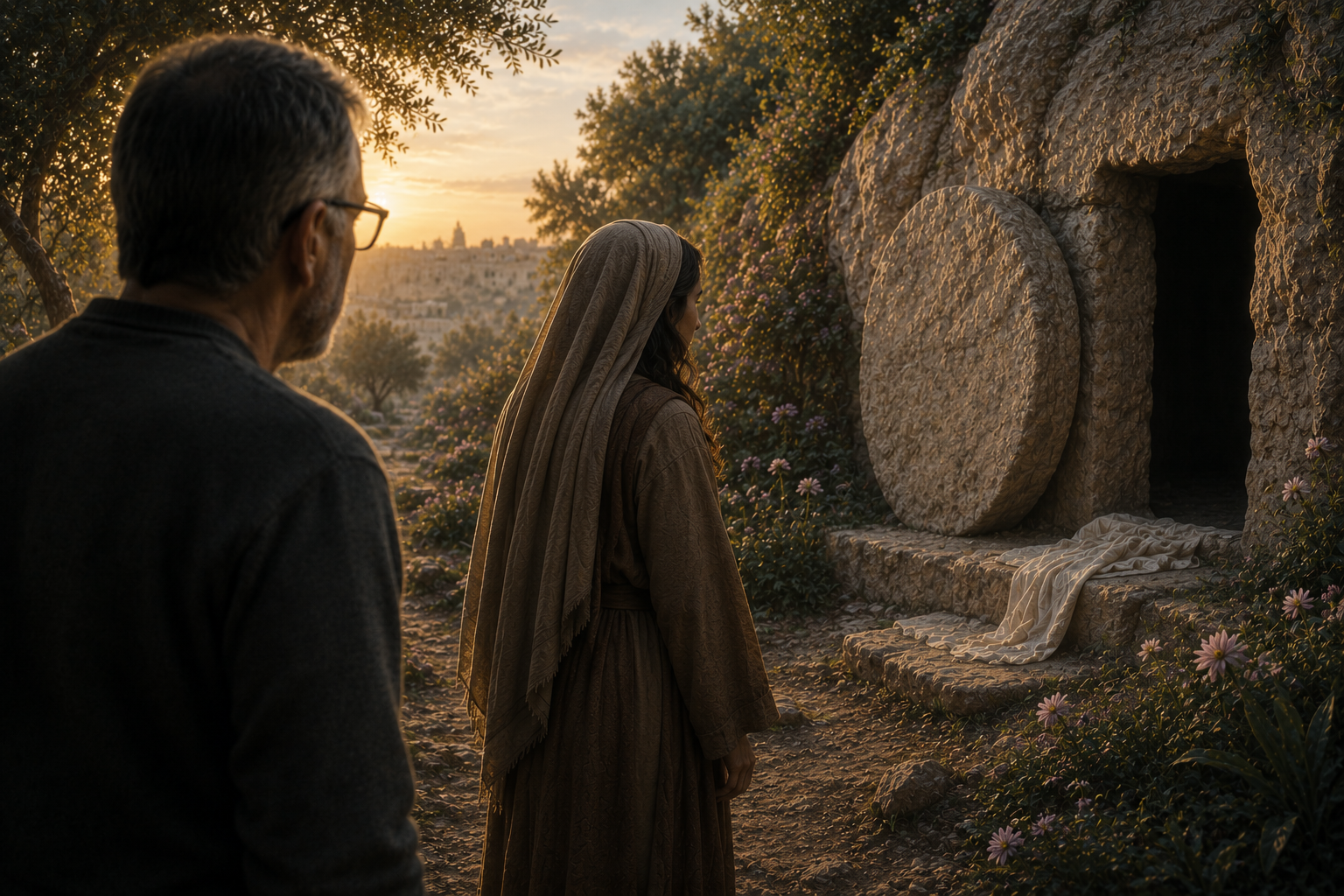
Sometimes revelation arrives only after we remain.
When Jesus Says Her Name
I keep returning to the moment when Jesus says Mary’s name. What am I to make of that? The angels didn’t use her name. Is there something here that I’ve overlooked for years?
It no longer seems to be the emotional climax of the story. Let’s look at what we know. Mary is grieving; Jesus appears; she recognizes him; and the scene moves forward. Yet the longer I sit with the passage, the more I suspect John wants us to notice something deeper. Could recognition not be the destination but the doorway?
When Mary first arrived at the tomb, she was searching for Jesus. More accurately, she was searching for what remained of him. But there were no remains. Overwhelmed by grief, she could only imagine one possible explanation. The body was gone. Someone must have taken it. Even though I’ve been in the dark blue water of grief, I can’t imagine what Mary is going through here. In a matter of hours, he was taken away from her, killed, and now taken away again. She did the only thing she knew to do. The only thing you and I could’ve done. She cried.
Even when angels appeared, she remained focused on the same problem. “They’ve taken him away.” Even when Jesus himself stood before her, she could not see him for who he was. “Where have you laid him?” I began to see how grief narrowed the range of possibilities she could imagine.
Then Jesus spoke her name.
What fascinates me is how little information is exchanged in that moment. Jesus does not explain the resurrection. He does not offer proof. He does not answer all the questions that have troubled Christians for two thousand years. He says, “Mary.” Somehow, that single word accomplishes what all the evidence in the world could not. She recognizes him.
“The most important things in life are rarely discovered through argument alone.”
I have begun to wonder whether recognition often works this way. The most important things in life are rarely discovered through argument alone. We may reason our way toward them, but at some point, there comes a moment of seeing—a moment when something that was hidden suddenly becomes obvious. We do not learn a new fact so much as recognize a reality that has been present all along.
The Pattern Emerges
Yet John refuses to allow us to linger there. Almost immediately, Jesus redirects Mary’s attention away from herself and toward others. “Go to my brothers and tell them…” The movement is so natural that I almost overlooked it. Mary receives something, and almost immediately, she becomes responsible for it.
Ahhh, there’s the pattern John wants me to see. It’s only after I’ve sat in this chapter for several days that it comes into view. The entire chapter is built around three movements: recognition, receiving, and responsibility.
Mary recognizes Jesus and receives a message. The disciples receive peace and receive a mission. Thomas receives understanding and a new way of seeing. In each case, the gift becomes an invitation to participate. Can you see it? Recognition, receiving, and responsibility. Once you do, you can’t “unsee” it.
Recognition. Receiving. Responsibility.
Maybe I’m overthinking it, but then I see John’s pattern of twos: two angels, one at the head and one at the feet, and two Marys, one at the beginning and one at the end of Jesus earthly life. Does John want us to see something here about those Marys?
Two Marys
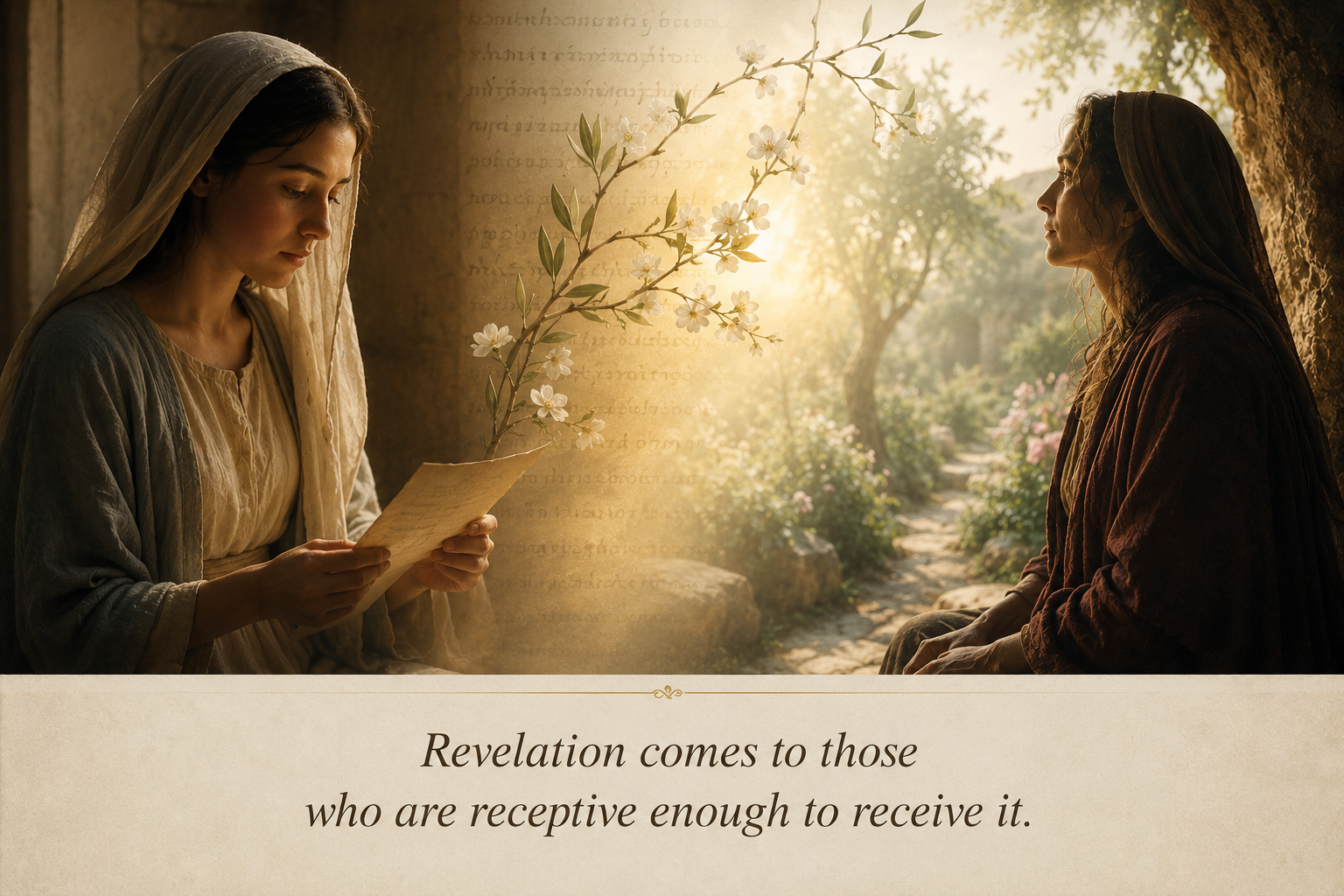
The first Mary is a young girl from Nazareth who receives a message she can scarcely comprehend. The second is a grieving woman from Magdala who receives a message she never expected to hear. Neither possesses status. Neither possesses influence. Neither belongs to the circles where important decisions are usually made. Not only that, but they both have a questionable past. Yet both become central figures in the story.
That cannot be accidental.
And suddenly I see it. The ancient world expected revelation to flow downward from the powerful. Emperors announced decrees. Priests interpreted God. Scholars explained truth. Yet John’s story turns that upside down. It fits Jesus’ pattern of “the first shall be last, and the last shall be first.” Revelation comes to those who are receptive enough to receive it.
The Gift of Receptivity
Receptivity may be one of the most underrated spiritual qualities in human life. We spend enormous energy trying to become knowledgeable, capable, influential, successful, or certain. Yet John seems strangely uninterested in those qualifications. The people who receive the most in his Gospel are often the people who know they do not have everything figured out.
Remember when Jesus once asked a lame man, “Do you want to be healed?” Strange question. Of course, he wanted to be healed. But receiving healing is not as simple as it sounds. To receive healing means accepting the responsibility that comes with it. It means standing up. It means carrying the mat. It means walking into a future that can no longer be blamed on yesterday’s limitations.
Isn’t that what happens to Mary in the garden? Her grief has given shape to her entire morning. Then, in a matter of moments, Jesus gives her a task. She is entrusted with a message. Her sorrow does not instantly disappear, but it is transformed. Her misery becomes her mission.
“Her misery becomes her mission.”
Peace Before Purpose
The same pattern unfolds later that evening. The disciples are hiding behind locked doors, paralyzed by fear. “Shalom.” Out of nowhere, Jesus appears, and his first gift is peace. I think that matters more than I first realized. Before he gives them responsibility, he gives them peace. Before he sends them into the world, he centers them. Before he asks them to carry the message, he gives them something else to carry, peace.
Only then, after they’ve taken a deep breath and their pulse has returned to normal, does he say, “As the Father has sent me, I am sending you.”
Until now, I have heard this as an assignment, but it’s actually an invitation. The disciples are not merely being asked to do something. Not just “I am sending you,” but “as the father has sent me.” He invites them into the same life that animated him. John has spent twenty chapters describing that life. He called it light. He called it truth. He called it spirit. He called it eternal life. Whatever language we choose, Jesus lived from a source deeper than fear, deeper than ambition, and deeper than self-preservation. Now the disciples are invited to receive that same life for themselves.
“Before he gives them responsibility, he gives them peace.”

Before he sends them, he centers them.
Thomas Stays
Then comes Thomas.
I have always had a soft spot for Thomas because he reminds me of the twin within me that refuses to pretend. He is not cynical. He is not rebellious. He wants his own encounter. I get that. The others have received something he has not yet received, and he is honest enough to admit it.
What I find most remarkable about Thomas is that he doubts - yet he stays. I think John wants me to see that. He remains with the community even while he struggles to understand what they are celebrating. He remains with the tension. He remains with the questions. He remains available.
Eight days later, Thomas finally sees what the others have seen. More importantly, he receives what the others have received. His availability becomes receptivity. The chapter that began with Mary recognizing Jesus now concludes with Thomas recognizing the reality that has been standing before him all along. I see it now: recognize, receive, and respond.
“He doubts — yet he stays.”
Receiving Life
When John finally tells us why he wrote his Gospel, he says that these things were written so that we may believe. Yet I find myself hearing that word differently than I once did. Belief sounds too much like agreement. John’s Gospel feels more dynamic, more interactive than that. “Believe” feels closer to trust. Closer to participation. Closer to the ongoing willingness to receive life from a source beyond ourselves and then accept the responsibility that comes with having received it.
Perhaps that is why this chapter continues to speak to me. It is not about proving what happened. It is a chapter about what happens to people when they become receptive enough to recognize life when it calls their name. Once they recognize it, they are invited to receive it. Once they receive it, they are invited to participate in it.
And that participation, John seems to suggest, is what eternal life has looked like all along.
“Once they recognize it, they are invited to receive it. Once they receive it, they are invited to participate in it.”
