
20.4 - Come Stand Where I’m Standing
Episode One: Seeing the Father
After four years of walking through John’s Gospel, I returned to two verses at the end of chapter 20. This time, I began to wonder whether John was asking me not merely to understand his story, but to stand where he was standing and learn to see what he saw.
A Scene Beneath the Scene
“There it is. Can you see it now?”
“No,” I said.
“Well, come here and stand where I’m standing,” she said.
So I did. I came and stood exactly where she was standing, and I still couldn’t see it. She smiled a “bless your heart” smile, and we moved on.
Here we are, years later, and I can close my eyes and see that smile. We were standing in a thrift shop that smelled like your grandmother’s basement, looking at a print popular in the ’90s. It was a Magic Eye print, a stereogram that hid a scene beneath the scene. Remember those? Some people could see both scenes. I could not. Still can’t. I could only see what’s right in front of me.
As I walked through the 20th chapter of John’s story with you, I felt that same thrift-shop frustration.
“What is it that I’m not seeing here?” I kept asking myself.
Sure, I could see the empty tomb, Mary, Peter, the angels, the gardener, Jesus, the other disciples, and Thomas touching the wounds. I have seen all those things for years.
I was taught not to look any deeper, but to fast-forward to the conclusion: He arose. Just believe it and go to heaven. At the time, I accepted it. Perhaps you did, too. Billions have, and that’s OK.
But Millie died, and the easy answers didn’t work anymore.
The God Jesus Trusted
I was so angry with God, my Sunday School God. You know, the one who wrote the rules, who knew the hairs on my head, had His eye on the sparrow, and wanted only good for me. That God sounded great, but did He really exist?
Is this the God that Jesus trusted?
I was utterly unsure, smothered in grief and deeply in doubt. Do you know that feeling? The one that comes when everything you had depended upon is no longer there? It felt like I was suspended in midair after someone quietly removed the scaffolding.
I felt there must be something missing in my childhood picture of God. I had to know. Could I uncover the real picture of the God Jesus trusted?
And the bigger question: Could I ever trust the God that Jesus trusted?
That’s when my imagination suggested, “Before abandoning God, why not partner with the apostle John? Look closely at what he said Jesus said about God. Ask him questions. Listen carefully. I’ll help you with the answers.
“Before you give up, let’s try to see what he saw.”
So, in the quiet of my early morning office, armed with a cup of coffee and a desperate imagination, I began this search. Almost every day for the last four years, I have pictured myself walking with John through his story, stopping to ask him questions and looking for the story beneath the words. Our mental conversations spread from my office to the garden and even on vacations.
I began to see how Jesus trusted His God.
But could I?
Come Stand Where I’m Standing
After finishing chapter 20, John put his hand on my arm and said, “Come, stand where I’m standing. Let’s look at it again. Maybe you can see it the way I saw it, from inside the story.”
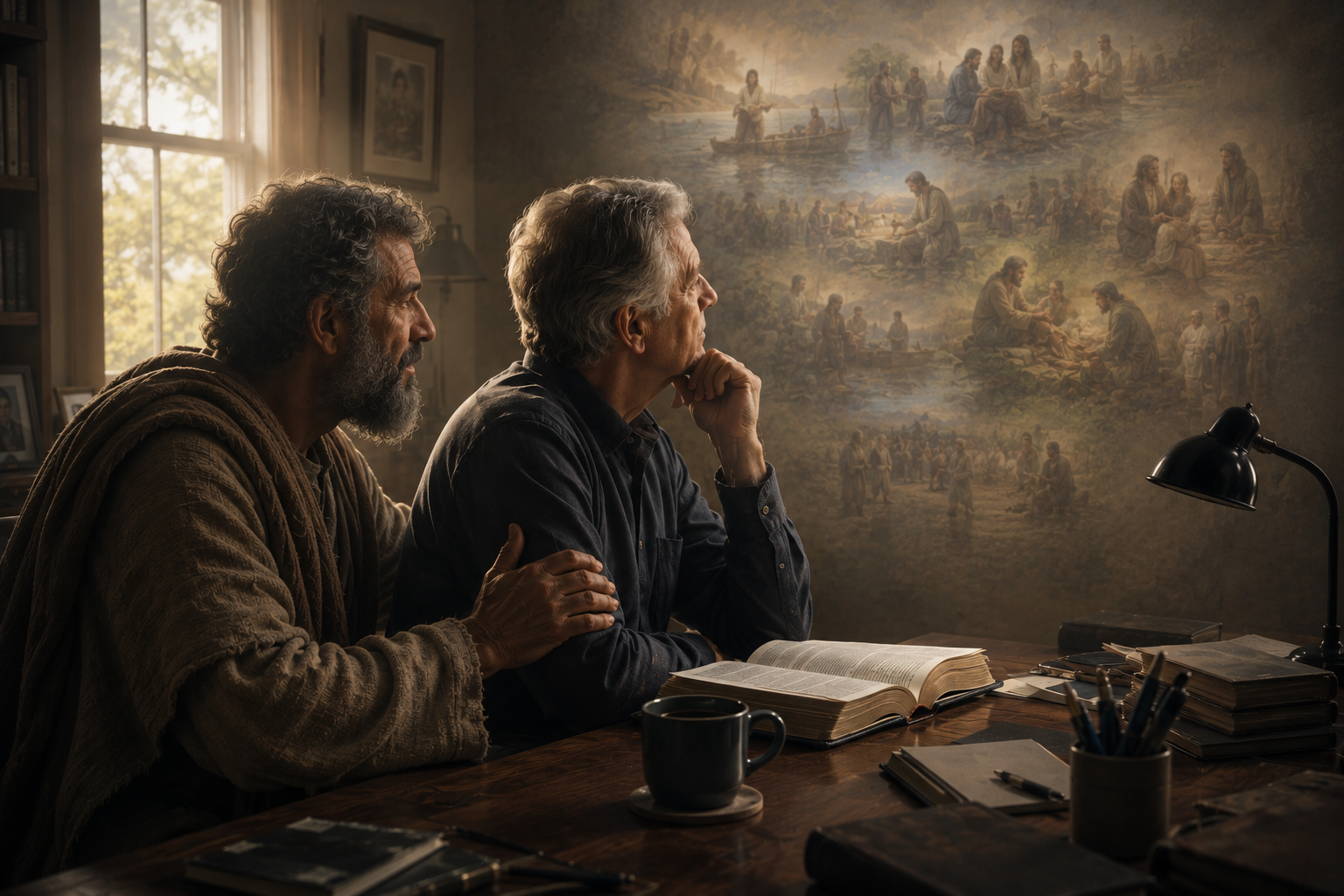
“It’s OK if you don’t see it immediately,” he reassured me. “Just keep looking.
“Ask yourself, what if this is not something to figure out? What if truth is not a knot to untie?”
He smiled and untied an imaginary knot in the air between us, looking down as if it dropped to the floor.
I stared at the rope for a long moment, letting my thoughts catch up with my vision.
“Yes, too simple. When a problem is solved, or a puzzle is done, it’s done,” I mumbled to the floor.
Looking up and back at him, I said, “Life is not like that. This is totally different. It’s more like a mystery. Mysteries have a life of their own.”
He added with a nod, “They grow richer the longer we live with them, don’t they?”
He chuckled under his breath, as if he were really pleased to see me learning something important. He paused, sitting quietly and looking at my office window.
I, on the other hand, scoured my memory for something Rilke had said to the young poet, something that echoed what I was beginning to see. It was slow in coming, but finally:
“Love the question. Live the question. One day you may live into the answer. But, by all means, live.”
I smiled, looking at John, still lost in thought.
“I think you and Rilke would’ve liked each other.”
He didn’t respond, but just seeing him there and having this thought brought a certain peace, a lighter feeling, and a deeper breath.
Was John lost in new thoughts or in his memories?
Anyway, I took advantage of the quiet, grabbed my Bible, and reread the first 20 chapters. This time, I would zoom out and look at the whole story as if it were a mural on my office wall. But not just a painting, a Magic Eye painting.
There was John the Baptist in the river. Nicodemus at night, the Samaritan woman at noon, the lame man lying by the pool, Jesus on the mount, feeding the 5,000, walking on water. The adulterous woman, the man born blind, Lazarus, the garden, the arrest, trial, crucifixion, and resurrection. It was all there.
What a painting!
Two Verses Come Into View
Three times, I read chapter 20 slowly. I looked up at the imaginary wall, then back down at the words. I let my imagination have its way. In time, two verses began to lift off the page through the images of the people and events.
I must’ve made a noise, because John was suddenly back with me.
“Look,” he said as he shook off his silence and pointed to the wall. “There it is. You see it?”
“Yes,” I said indecisively. “I think I do, but I don’t quite understand it.”
“Take your time,” he said with a reassuring smile.
“Don’t solve it; just see it.”
I felt as if he was repeating something he had heard before.
So, on the advice of a German poet and a Jewish prophet, I began to live with verses 17 and 31, looking closely from every angle, gazing between the words themselves.
Not solving, just seeing.
This is where you might want to pause and spend some time with the verses yourself and let them trigger your imagination. I’ve learned over the years that your insight matters most. Yours is the only insight that produces life in and through you. We each have to see it for ourselves.
However, you’re welcome to follow John and me through the process, but I warn you, it can be painful. It gets pretty granular in here in my imagination.
“I Ascend”
Verse 17:
“I ascend to my Father and your Father, and my God and your God.”
“I ascend.”
I began to think out loud.
“One does not appoint himself to ascend. He or she must be invited. The Romans saw a comet and concluded, ‘Caesar has ascended. Hail Caesar!’ It was a sign of how majestic and powerful he had been in life. But Jesus, a blue-collar carpenter of questionable parentage from a blink-and-you-miss-it town like Nazareth? That would have been out of the question!”
John seemed to nod.
“When I look at it this way, John, I see, or at least I think I see, that you’re writing less about Jesus’ earthly qualifications and more about the character of the one doing the inviting, the appointing.”
No expression, as he let me settle into my thoughts.
“Are you saying, ‘Don’t just look at Jesus, but look at God’? That He has no regard for man’s definition of status and power?
“Is that what He wanted you and the others to see?”
John shifted in his seat, which I took as approval, and added, “He would never have said, ‘Look at me, I ascend.’ But it’s so like Him to say, ‘Look at Him who has invited even me.’”
And then John took a long, exaggerated breath and shared something that stopped me.
“Jesus never liked just telling us things. He gave us pictures. Stories. Examples. Looking back now, I think He wanted us to see what God was like... what God was doing.”
“Sit with that for a minute.”
“To My Father”
“To my Father!”
I think I might’ve scared him, but I continued.
“Not to the gods or the heavens, like Caesar, but to my Father. That’s important, isn’t it?”
I saw in his eyes, “You’re on to something. Keep going.”
Was I beginning to see God emerge from this painting? I was out on a limb here, but I decided to use my words to press forward.
“I think you wanted me to see how this carpenter-turned-Rabbi experienced the Creator of the universe. Not as the distant ‘manager of the cosmos’ or a stern ‘scorekeeper’ with a bag of lightning bolts, but as something totally different: a Father.”
John sat up straight, closed his eyes, and suddenly he was back inside the story with Jesus.
“He loved to tell us, and anyone who would listen, about the time He went to the temple at age 12. I can hear Him laughing and saying, ‘I told them I must be about my Father’s business.’
“‘What?’ we would joke. ‘Your father is a carpenter. You want to be making windows for the temple?’
“He would just shake His head and walk away, but we knew His view of God had always been as His ultimate Father.”
That thought helped me see more clearly.
John continued, “Jesus saw everything in terms of this relationship. It told Him who He was. So, you’re right, no scorekeeper, no manager.”
After another long breath, he leaned over as if letting me in on a secret.
“It took a while, but we eventually saw that He was in partnership with the Father. There was no up there and down here. It was all right here, right now. ‘He in me and I in Him’ is the way He put it. To be honest, that kind of talk scared us for a while.”
Partly guessing, I said, “Presence. Relationship. Partnership. Those seem to be the keywords here.”
“Don’t try to reduce it to words,” he immediately corrected me.
Pointing to his eyes, he said, “Try to see it.”
And, pounding his heart, “Try to experience it.”
It stung a little, but I got the point.
“If you must have words, try these: ‘In Him was life... and that life was the light of men.’”
“Life,” I repeated. “In. Him. Was. Life!”
“And Your Father”
More silence.
This time, I waited for John to say something. It proved to be a smart move because he broke the silence of my vivid imagination.
“I wish you could have been there when Mary came in with His message.
“‘My Father.’
“We could now understand that.
“But then she added something that none of us were ready for: ‘and your Father.’
“Frankly, it scared us.”
There was a new energy in him now.
“We made her repeat it several times. ‘My Father, and your Father.’”
As John said it, he got up and paced across the room, repeating it to himself in some form of a reenactment.
I met him on the return with a question.
“Scared? Why scared?”
“Alan, from where you’re sitting, I know it all sounds nice and spiritual. But from where we were sitting, it was too personal, too engaging, even dangerous.”
“It sounds like He was inviting you into His relationship,” I offered, “calling you off the shore and into the same boat, so to speak.”
“It was too much to take in,” he answered and returned to his chair.
As I thought about my own life, I began to see something else. There’s a part of me that wants to keep God at a distance, up there somewhere.
Do you?
It allows me to read, think, and sing about Him and still go on my merry way here on the shore.
“This is certainly not what John is talking about,” I thought aloud.
“You’re smiling,” John said.
“Am I?”
“Have you realized why it frightened us?”
“Jesus is calling us off the shore and into the boat?” I offered.
“Keep thinking,” he said, sensing the fear in my voice.
“It’s dangerous, but what else?” John asked with a new brightness in his eyes.
I hesitated.
“It also sounds exciting... but didn’t that change the way you viewed everything?”
John simply rubbed his beard.
“My Father and your Father,” I summarized. “It’s look-me-in-the-eye personal.
“Are you saying I have to deal with what I see on that level? The level where it’s personal... and dangerous... but exciting? Wouldn’t that change how I view everything?”
He let me hang there for what seemed like forever and then said softly:
“And that puts you at a crossroads where the next verse connects.”
The Crossroads
I closed my Bible and sat quietly for a long time. I wasn’t ready to answer John’s questions yet. But for the first time, I realized they were the right questions.
If Jesus had truly invited His followers into the same relationship He shared with the Father, then verse 31 might not simply explain what we are to believe.
It might explain what that belief is meant to become.
Before moving to the next episode, sit quietly with Jesus’ words:
“My Father and your Father.”
Do not rush to explain them. Notice what they awaken in you. Comfort? Resistance? Fear? Possibility? Let the question remain open long enough for something new to come into view.
For my grandchildren, I hope you never feel ashamed of your questions. Questions do not necessarily lead us away from faith. Sometimes they are the doorway through which a deeper and more honest trust begins. When the easy answers fail, keep looking. Stand close to the story. Look at Jesus. Pay attention to the God He trusted. Then give yourself time to see what slowly comes into view.
Next in the John 20 Epilogue: Episode Two explores John 20:31 and the difference between believing something and trusting it enough to live by it.
