
21.3 - Do You Love Me?
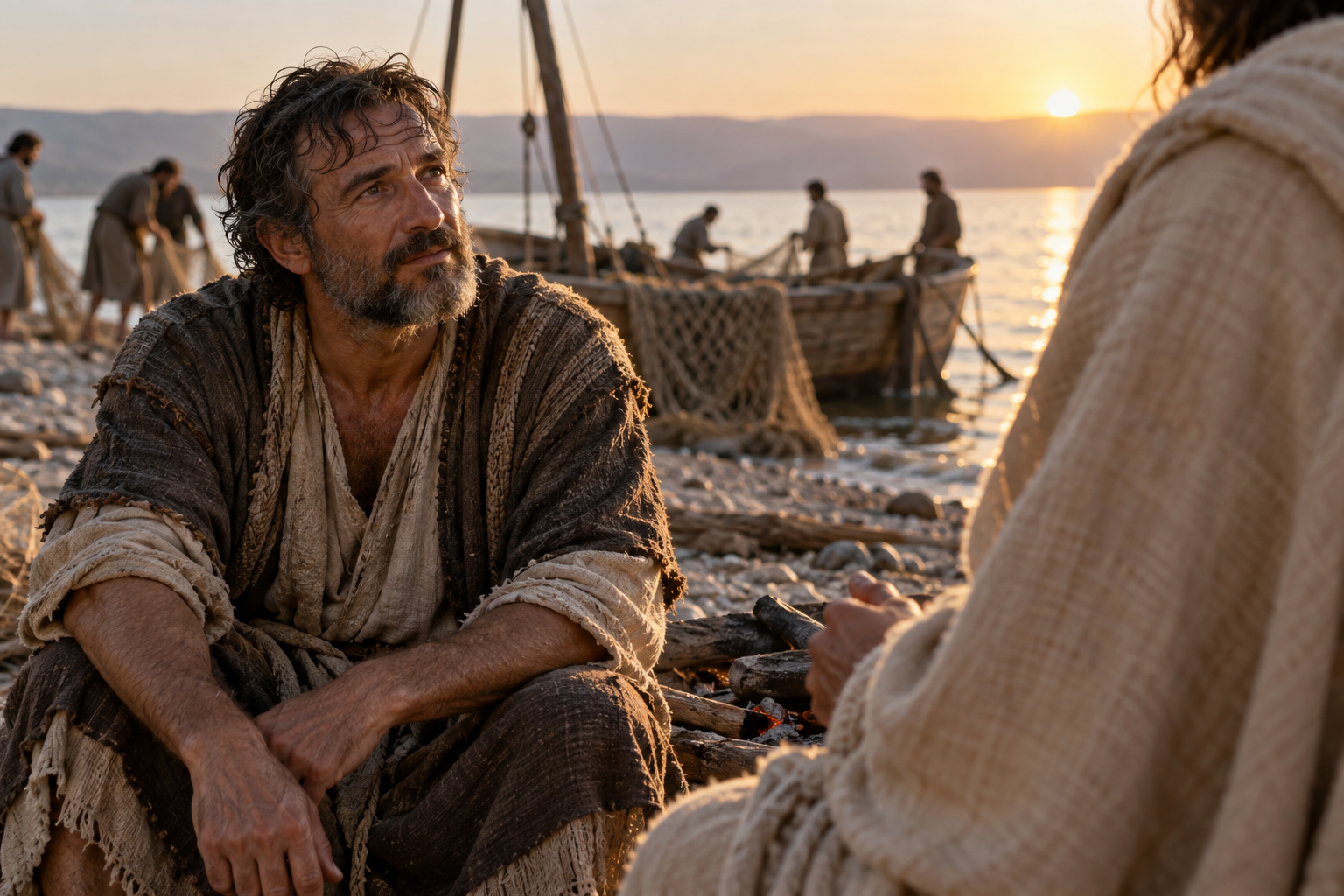
He becomes Peter. And he remains Simon.
When Words Become Flesh
John 21:15–17
Breakfast is over.
The fish have been eaten. The bread passed around. Seven tired men are still gathered beside the Sea of Galilee.
John makes a point of telling us that the conversation that follows happens after they had eaten breakfast.
I think that matters.
Jesus has already fed them before he asks anything of them.
Peter has already had quite a morning. When John recognized the man on shore and said, “It is the Lord,” Peter jumped into the water and made his way roughly a hundred yards to shore.
Later, when Jesus asked for some of the fish they had caught, Peter went back and hauled the net ashore himself.
All 153 fish.
Then Jesus calls his name.
“Simon, son of John.”
That caught my attention.
Not Peter.
Simon, son of John.
So I went back to the beginning.
The first time Jesus meets him, Andrew brings his brother Simon to Jesus. John says Jesus looks at him and says:
“You are Simon son of John. You are to be called Cephas”—Peter.
I've read those words countless times. I don't think I had ever noticed what happens to them.
From there on, John usually refers to him as Peter or Simon Peter. Peter becomes one of the story’s central figures. He speaks up. He gets things right. He gets things wrong. He promises to lay down his life for Jesus. Then, before the night is over, he denies knowing him three times.
He becomes Peter.
And he remains Simon.
Now, twenty chapters later, beside another charcoal fire, Jesus doesn't say:
“Peter, do you love me?”
Three times he says:
“Simon, son of John.”
I don't know exactly what to make of that.
At first I wondered whether Jesus was stripping Peter of his title because he had failed. But that doesn't fit what happens next. Jesus isn't demoting him. He's about to entrust people to his care.
So maybe something else is happening.
Maybe Jesus knows Simon on a deeper level than either his successes or his failures.
“You are Simon, son of John.”
I know who you are.
“You will be called Peter.”
And I know what you can become.
He knows us at our base level, complete with our potential for success and failure, and still calls us forth.
Maybe that's what it means to be known by Jesus.
That lands close to home.
My father was George. He ran a small corner grocery store where I began my work life.
Since then, I've accumulated quite a few identities. Retired insurance executive. Voiceover artist. Sunday school teacher. Husband. Father. Grandfather. Writer.
I've accumulated failures too.
But none of those seem to be where Jesus meets me.
At that deepest level, I am simply Alan, son of George.
Not because everything that came afterward doesn't matter. It does.
Maybe it's because Jesus already knows all of it.
And somehow the invitation remains.
“Follow me.”
I'm beginning to think Jesus doesn't call us out nearly as much as he calls us forth.
That's different.
Calling Peter forth doesn't erase what happened beside that other charcoal fire. Peter will carry his failure with him. Maybe it will even become part of what makes him capable of tending sheep. He knows what it's like to fail and still be invited to breakfast.
Maybe Jesus saw Peter in Simon from the beginning.
Not a title to achieve.
Maybe Jesus saw Peter in Simon from the beginning.
A person to become.
And now, after everything that's happened, Jesus is still speaking to the man he first saw.
“Simon, son of John.”
Then comes the question.
“Do you love me more than these?”
More Than These?
I've wondered what these means.
More than these other disciples love me?
Do you love me more than you love them?
More than the boats and nets and fish?
People have been debating that question for a very long time, and I don't intend to settle it here.
Peter is still wet.
A huge net of fish lies nearby.
He has been the most visibly active person on that beach.
He swam to Jesus.
He hauled the net ashore.
Peter seems to do everything big.
And I recognize something in that.
I study the Bible a great deal. I think about these things a lot. I've spent hundreds of hours writing this project.
And there's a subtle danger in that.
I can begin to think that because I spend more time thinking about God, I must love God more.
The moment I do that, something happens.
Distance.
I'm here.
They're there.
Maybe that's why I find Jesus' response to Peter so interesting.
Peter doesn't establish how much more he loves Jesus than anybody else.
He simply says:
“Yes, Lord; you know that I love you.”
And Jesus turns Peter's attention away from himself.
“Feed my lambs.”
That exchange stops me. Peter's love is directed toward Jesus, but Jesus immediately gives that love somewhere to go.
Maybe the question isn't simply whether Peter loves Jesus. Maybe the question is what that love becomes.
Maybe Tending Isn't Another Thing to Do
It may be a way of being in what you're already doing.
I want to keep those words in front of me because my natural tendency is to turn everything into an assignment.
“Feed my lambs.”
Okay. Who are my lambs? What do they need? What should I do?
I can almost see myself reaching for a legal pad. Call this person. Help that person. Spend more time with the grandchildren. Volunteer somewhere. Write another blog post.
And suddenly Jesus has given me another to-do list.
Worse, he's given me one I can never finish.
That reminds me of something my friend Bill Thomas used to tell me.
I don't remember his exact words, but it was something like:
“Don't think of Jesus and your to-do list as two separate things. Think of Jesus in your to-do list.”
I understood what Bill meant.
I'm not sure I've always lived it.
Maybe Jesus isn't giving Peter another list.
Maybe he's changing the way Peter enters the life he already has.
But perhaps action isn't where this conversation begins.
It begins with:
“Do you love me?”
Maybe alignment comes before accomplishment.
Maybe accomplishment is what grows out of alignment.
Breakfast Was Already There
Then I notice something else.
Jesus has already shown Peter what this looks like.
Breakfast was waiting.
Seven men came ashore after working all night.
Jesus didn't begin with a lesson.
He didn't begin by discussing Peter's failure.
He didn't hand out assignments.
He said:
“Come and have breakfast.”
Fish. Bread. A charcoal fire. Hungry people.
Only after Peter has been fed does Jesus say:
“Feed my lambs.”
Maybe that's coincidence.
But I don't think I can read those two scenes separately anymore.
Jesus does something for them.
Then asks Peter to do something for others.
I wonder if he's saying:
If you want to know what love looks like, Peter, you just ate it.
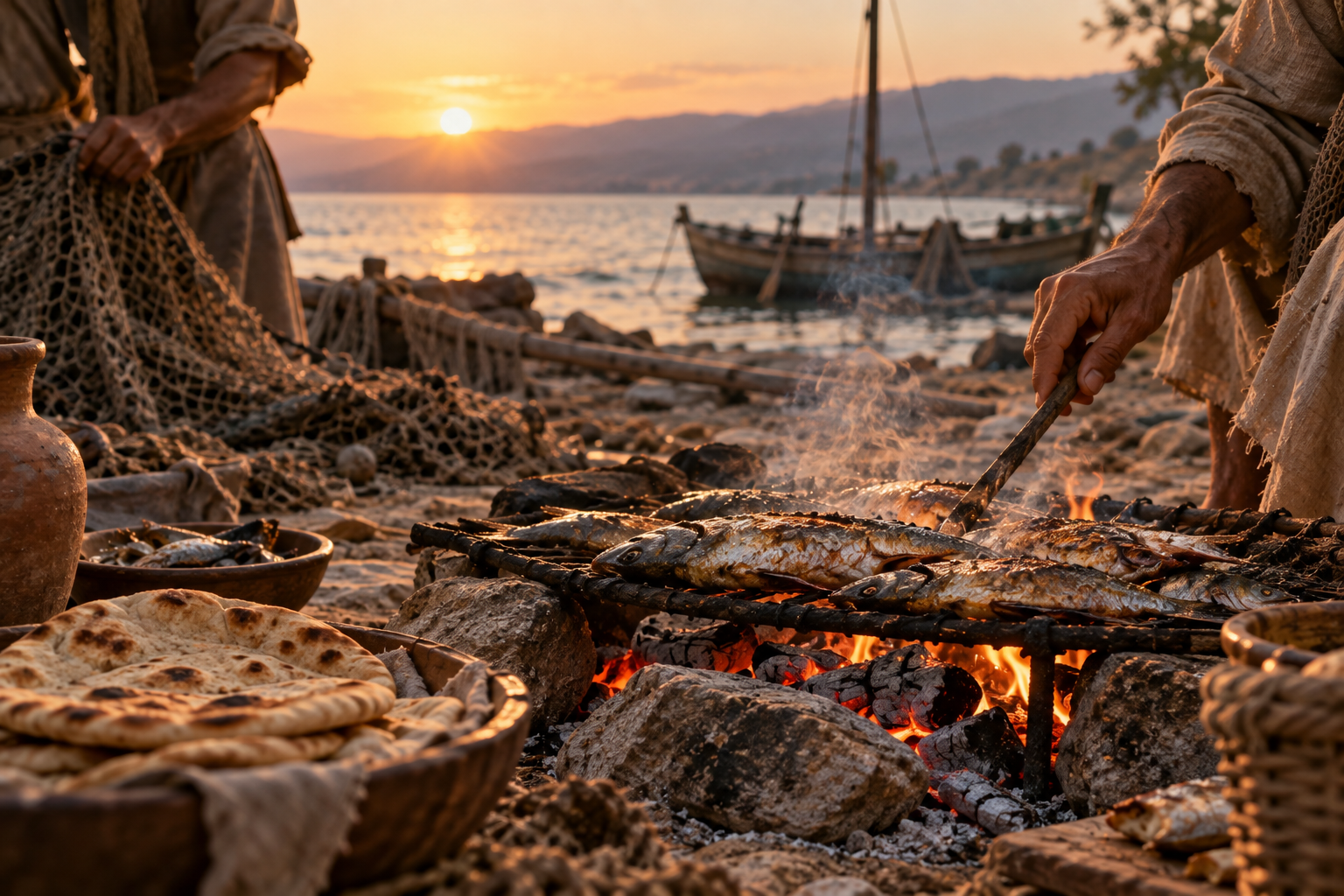
Before Jesus asked Peter to feed anyone, Peter had been fed.
Tend My Sheep
Jesus asks again.
“Simon, son of John, do you love me?”
“Yes, Lord; you know that I love you.”
“Tend my sheep.”
That feels like something more than feeding.
You can feed someone and leave.
Shepherding is different.
The sheep's well-being becomes part of the shepherd's life.
He stays near enough to notice. Near enough to protect. Near enough to redirect. Near enough to care what happens next.
Jesus had already used that image earlier in John's Gospel.
“I am the good shepherd.”
The shepherd knows the sheep.
The sheep know his voice.
The shepherd cares enough about their well-being to lay down his life.
Now Jesus gives Peter that same image.
Maybe sacrifice for Jesus isn't primarily about doing increasingly impressive things for Jesus.
Maybe sometimes it means letting another person's interests become important to me.
Not because they're on my list.
Because they matter to someone I love.
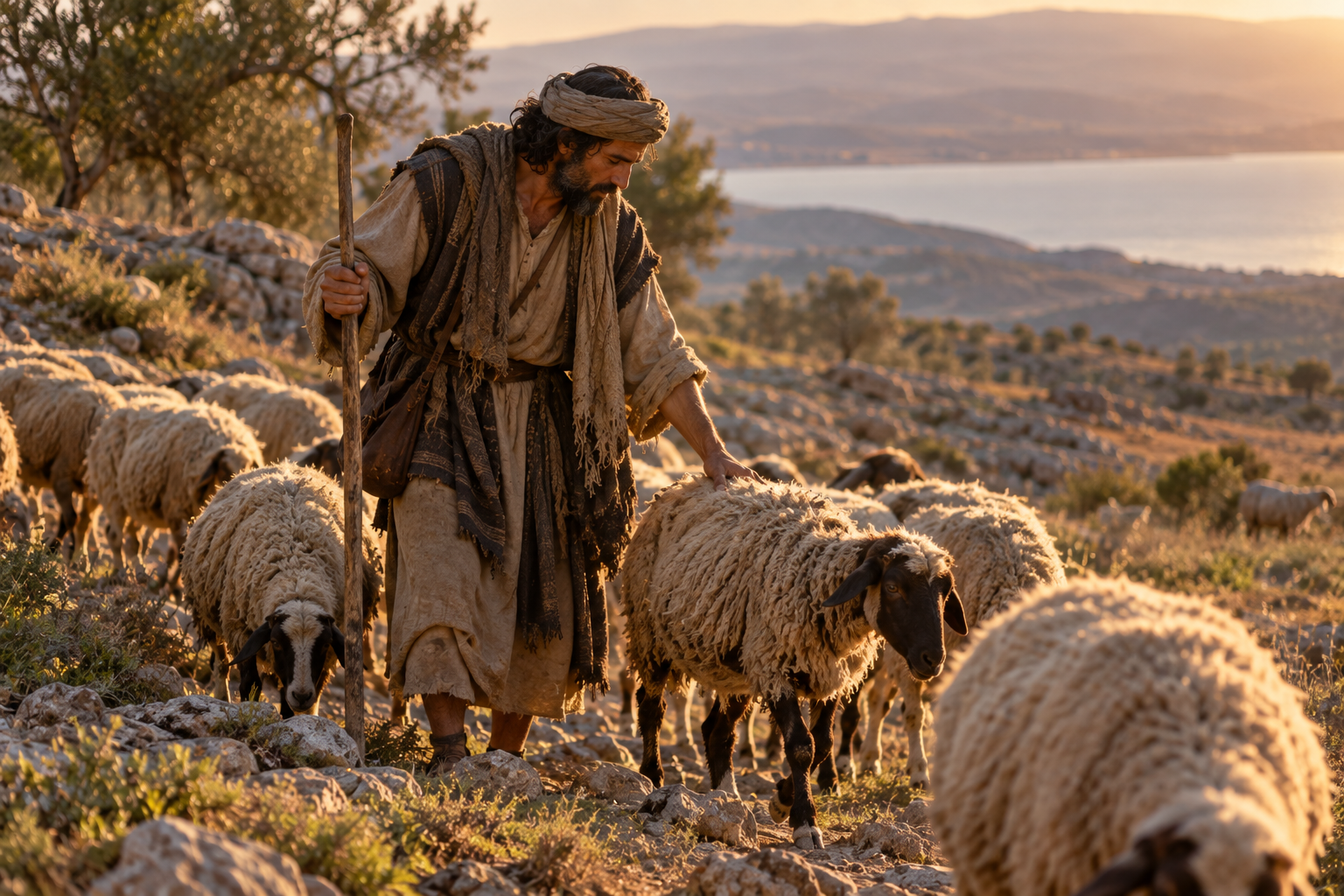
The sheep's well-being becomes part of the shepherd's life.
The Third Time
Jesus asks again.
A third time.
Peter is hurt.
John tells us that.
I can't hear three questions without remembering three denials.
Especially because there was another charcoal fire that night.
But Jesus doesn't make Peter relive what happened beside that fire.
He doesn't demand three apologies.
He doesn't put Peter on probation.
Peter has already eaten breakfast.
He's already sitting in the circle.
Three times Peter gives Jesus a word.
Three times Jesus gives the word somewhere to go.
I've started wondering what that looks like in my own life.
It isn't usually dramatic.
Sometimes it's simply a nudge to stay in a relationship when I'm busy and would rather move on. Occasionally something unexpected grows from that relationship, and I find myself thinking:
There's Jesus.
Other times it comes in the middle of tension, when my instinct is to withdraw or react.
Be the peace.
I'm not always sure it changes anyone else. But it changes how I enter the moment.
And sometimes the nudge is surprisingly practical:
Tell the truth. You're overcommitted.
I'm learning that following Jesus doesn't always mean saying yes or sacrificing more. Sometimes it means setting a boundary without abandoning the relationship.
These moments are beginning to feel like variations of the same invitation:
Follow me into this situation and see what happens.
Not because everything will turn out the way I want. I've lived too much life to believe that.
Sometimes following is delightful. Sometimes it's hard.
And sometimes you follow as faithfully as you know how, and the thing you desperately wanted still doesn't happen.
I know that too.
When Words Become Flesh
As I sit here in my predawn office, I keep coming back to the beginning of John's story.
“The Word became flesh and lived among us.”
For twenty-one chapters, John has been showing me what those words look like.
Water turned to wine.
A conversation with a woman beside a well.
Bread for hungry people.
Blind eyes opened.
Dirty feet washed.
A grieving woman called by name.
Breakfast waiting beside a charcoal fire.
And now:
“Feed my lambs.”
“Tend my sheep.”
“Feed my sheep.”
The Word became flesh.
And now I wonder if the Word is inviting ordinary people to let his words take flesh in ordinary lives.
Love becomes care.
Compassion becomes attention.
And “yes” becomes a way of moving through the world.
I'm still trying to figure out what I believe. More importantly, I'm trying to discover what I trust enough to live.
I want a faith that works in the world as it actually is.
A world where friendships unexpectedly produce something beautiful.
A world where peace sometimes changes a room and sometimes doesn't.
A world where telling the truth can preserve a relationship and sometimes cost one.
A world where little girls die even when everybody prays for them.
Any faith I have left has to live in that world.
Maybe that's why Jesus' question feels different to me now.
“Do you love me?”
Yes.
Then don't just tell me.
Follow me into your marriage.
Follow me into your friendships.
Follow me into the uncomfortable conversation.
Follow me into the moment when you'd rather withdraw.
Follow me into the decision to say no.
Follow me into Tuesday afternoon.
And see what love looks like there.
Jesus looks me in the eyes.
“Follow me.”
Then he turns and walks.
I don't know everything that lies ahead.
I don't need to.
I only have to decide whether to take the next step.

Follow me into Tuesday afternoon.
Maybe following Jesus is less about finding another thing to do and more about discovering how to enter the life already in front of me.
