
21.2 - Come and Have Breakfast
John 21:7–14
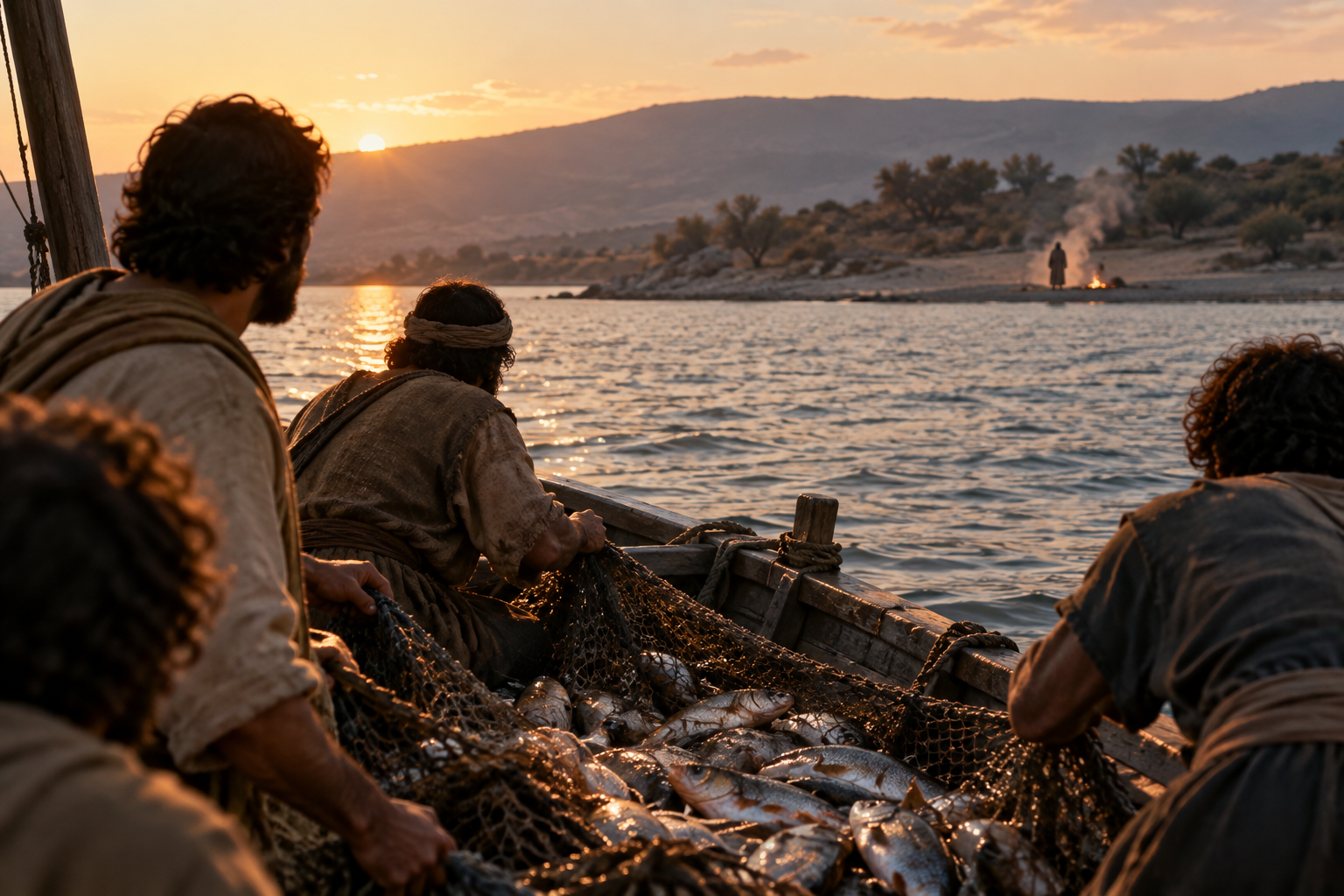
John couldn't have seen his face clearly. Yet something inside John recognized something outside John.
“It is the Lord!”
John sees him first.
That fascinates me because there is no reason to believe John could actually see him clearly. The boat is still about two hundred cubits from shore—roughly a hundred yards. Close enough to see a man standing beside a fire. Probably too far away to recognize his face.
Yet John knows.
“It is the Lord!”
It’s as if John keeps bringing me back to recognition.
Mary thought Jesus was the gardener. The disciples were behind locked doors before they recognized him. Thomas needed to see the wounds. And now seven disciples have spent the night fishing while a man stands on shore asking whether they have anything to eat. They don't recognize him either.
Until something happens.
The net fills with fish.
And something inside John recognizes something outside John.
“It is the Lord.”
Learning to Recognize
I've spent much of my life thinking recognition works from the outside in. I see something, gather enough information about it, understand it, and finally decide what it is.
But I'm beginning to wonder whether spiritual recognition sometimes works in the opposite direction.
From the inside out.
John couldn't have made out the man's face from a hundred yards away. But something about what had just happened—the voice, the instruction, the abundance, perhaps even a memory of another impossible catch of fish—caused something within him to say, I know who that is.
Maybe recognition is something we learn, and something that improves with practice.
Maybe the question isn't simply, “Where is God?”
Maybe it's also, “Am I becoming the kind of person who can recognize God when God doesn't look the way I expect?”
And then I hear, “Don’t expect Jesus always to look like Jesus.”
That's a strange sentence, but I think there's something in it for me.
If I expect God only in church, I may miss him on the shore, cooking breakfast.
John recognizes.
And Peter moves.
Closing the Gap
As soon as Peter hears John say, “It is the Lord,” he puts on his outer garment and throws himself into the sea.
I've always found that detail wonderfully strange.
He puts on more clothes before jumping into the water.
That sounds like the sort of unnecessary detail somebody remembers because he was there.
And then Peter swims—or perhaps wades and swims—the hundred yards toward Jesus.
The others stay with the boat and bring in the fish.
Why was Peter the only one who jumped?
I don't know.
Maybe that question is more interesting if I leave it unanswered.
But I do know what his action did.
It closed the gap.
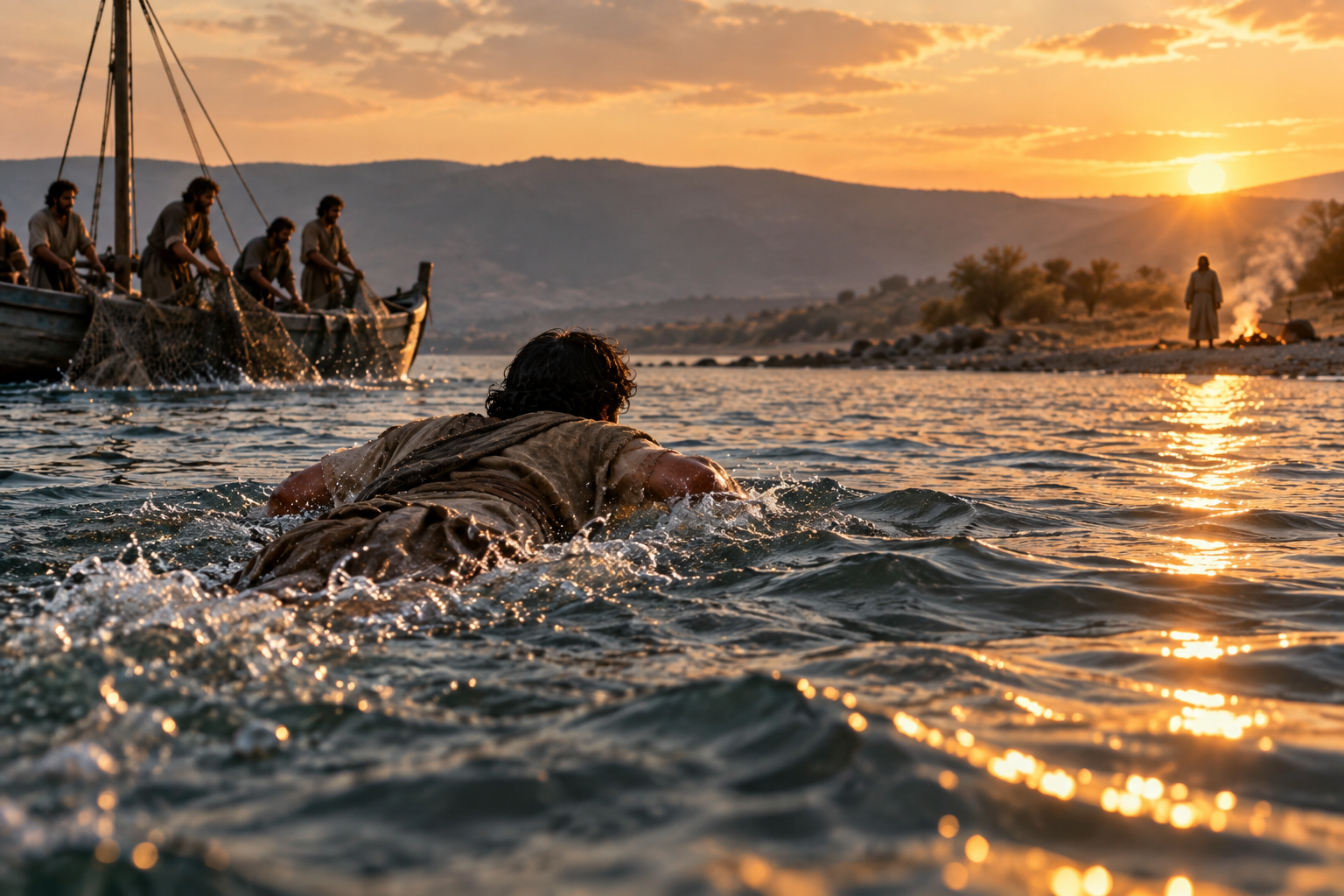
Once Peter wanted Jesus to go away. Now he couldn't get to him fast enough.
Another fishing story keeps coming to mind. In Luke 5, after another enormous catch of fish, Peter falls before Jesus and says, “Go away from me, Lord.”
The abundance frightened him. Recognition created distance.
Now, after everything that has happened—after following Jesus, failing him, denying him, watching him die and encountering him alive—Peter recognizes Jesus and moves in exactly the opposite direction.
Toward him.
I don't know whether John intended the comparison. But I can't unsee it.
Once Peter wanted Jesus to go away.
Now Peter can't get to him fast enough.
And I understand that.
If I looked across the street tomorrow and saw Millie standing there, I wouldn't question whether it was safe to cross. I wouldn't calculate the traffic pattern. I wouldn't look for the crosswalk.
I'd run.
Breakfast Was Already There
But what Peter finds when he reaches shore may be even more important.
A charcoal fire.
Fish.
Bread.
Breakfast was already there.
I wish John had told us more.
What happened when Peter came dripping out of the water? What did Jesus say? What did Peter say? Did they embrace? Did they simply look at one another?
John doesn't tell us.
Instead, he tells us about breakfast.
These are hungry, exhausted men. They have worked all night. Imagine smelling that fire from the boat. Imagine the fish cooking.
Then consider who is gathered around that fire.
Peter, who denied him.
Thomas, who doubted.
Two unnamed disciples.
And Jesus has breakfast waiting for all of them.
Jesus had once told Philip, “Whoever has seen me has seen the Father.”
If that's true, then look carefully.
What kind of Father are we seeing?
Not one waiting for Peter with crossed arms.
Not one demanding Thomas explain himself.
Not one standing over the fire saying, “Before we eat, we need to talk about what you fellows did.”
The fire is already burning.
The fish is already cooking.
The bread is already there.
Grace got there before they did.
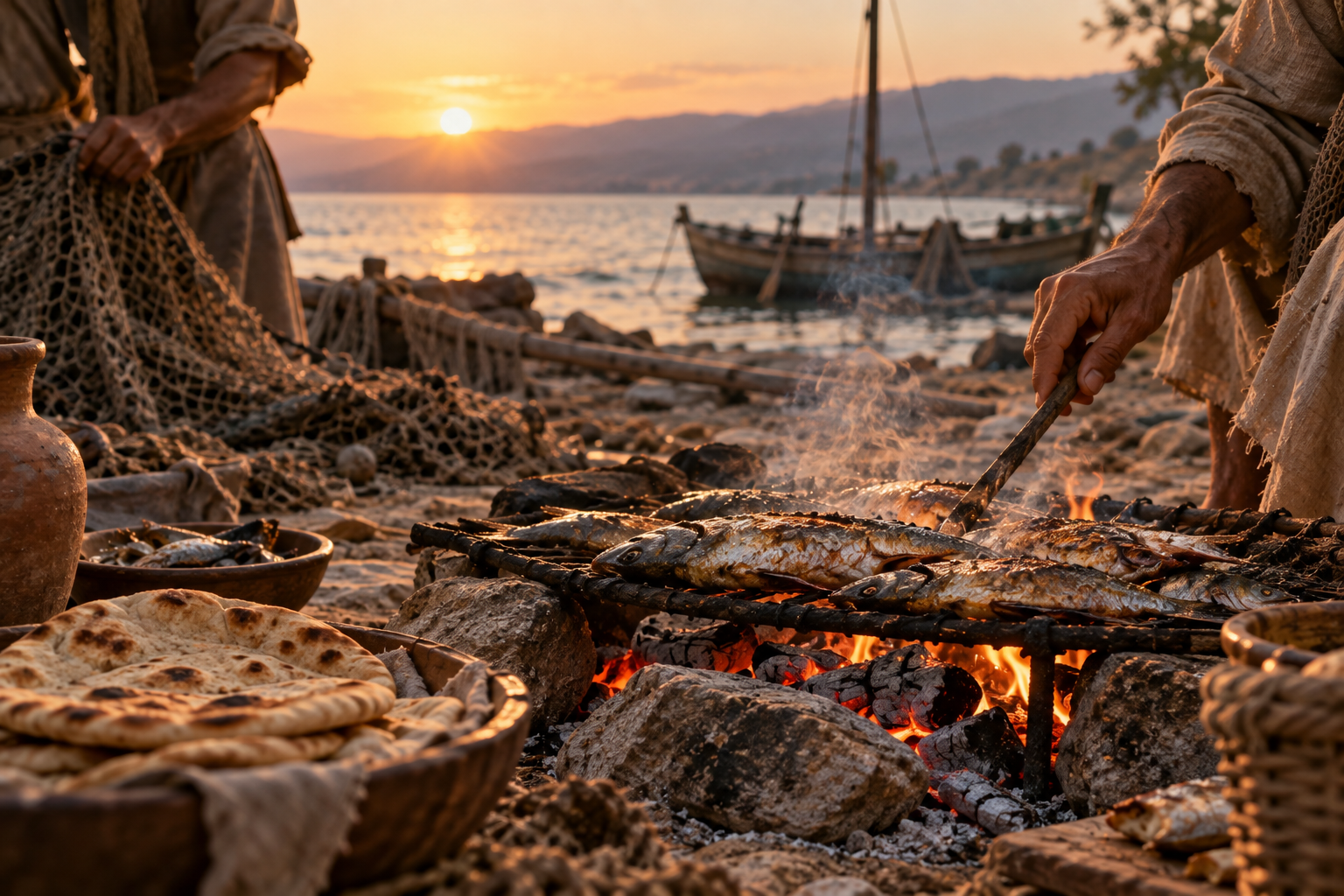
Before they brought anything, the fire was already burning.
Bring Some of Yours
Then Jesus says something I love:
“Bring some of the fish that you have just caught.”
Wait.
Why?
Jesus already has fish.
Apparently this isn't simply a meal Jesus is providing for them. They are going to contribute to it.
Their fish will go beside his fish.
It's a potluck.
That may not be the most sophisticated theological description of John 21, but I like it.
Someone has to drag the net ashore. Someone has to select some fish. Someone has to clean them. Someone has to put them on the fire. And all of that takes time.
Suddenly, this isn't religious. It’s breakfast.
It's breakfast with friends.
Jesus doesn't need their fish, but asks for them anyway. Both end up on the same fire.
And Peter responds in typical Peter fashion. Jesus says, "Bring some fish,” and Peter goes after the net.
Years later, John even remembers how many: 153 large fish.
One hundred fifty-three.
They counted them.
Of course fishermen counted them.
And they were large fish—keepers. Fish they could eat or sell. And somehow the net, stretched by this ridiculous catch, didn't tear.
John remembers that too.
A hundred yards from shore.
A charcoal fire.
Bread.
Fish.
One hundred fifty-three of them.
Theological details? Maybe. But to me, it still smells like somebody's memory.
I can almost hear an old fisherman saying, “No, really. There were 153. I was there.”
“Come and Have Breakfast”
Then Jesus speaks:
“Come and have breakfast.”
After a night like that, I wonder whether they had ever heard more beautiful words.
John says none of them dared ask, “Who are you?” They knew.
Recognition has become something deeper now.
Reverence.
But not the kind of reverence I grew up imagining.
Nobody is kneeling in a sanctuary. They're sitting around a charcoal fire eating fish with their hands.
Maybe reverence is recognizing what is already holy.
And then treating it that way.
Jesus takes the bread and gives it to them. Then the fish.
The one who should be served is serving again.
I hear echoes everywhere.
“The Son of Man came not to be served but to serve.”
“Give us this day our daily bread.”
“The Lord is my shepherd; I shall not want.”
But John doesn't explain any of this.
He gives us a picture.
God with bread in his hands.
God feeding hungry men.
God serving people who failed him.
The Third Time
John finishes by telling us this was the third time Jesus appeared to the disciples after being raised from the dead.
Again, a specific detail.
And again, I don't want to make it carry more weight than John gives it.
But I do find it interesting that John's resurrection story brings us here.
To a shore in Galilee.
To work.
To a boat and a net.
To tired people and breakfast.
At the end of chapter 20, John told us why he wrote these things: that we might trust, and that through trusting we might have life in Jesus' name.
Then he gives us another chapter. Why? Maybe this is part of the reason. Resurrection has moved out of the locked room and into ordinary life.
John recognized Jesus from a hundred yards away.
I'm trying to learn to recognize him much closer than that.
In the ordinary.
In other people.
In bread offered.
In relationships repaired.
In the quiet invitation to contribute what I have.
In opportunities to serve rather than be served.
And sometimes, perhaps, in the simple words:
Come and have breakfast.

Sometimes the holy is already waiting for us in something as ordinary as breakfast.
Maybe learning to recognize God begins by noticing the love already preparing breakfast.
