
Learning to See Like Jesus
John 21:15–19
I've been thinking about Peter's job description.
For most of his life, Peter had been a fisherman. He knew how to find fish, catch them, and bring them ashore. It was work he understood.
Now, sitting beside a charcoal fire after breakfast, he hears Jesus describe an entirely different kind of responsibility.
"Feed my lambs. Tend my sheep. Feed my sheep."
That stopped me - and started my imagination. Jesus is asking a fisherman to begin thinking like a shepherd. And those are two different ways of looking at the world.
A fisherman looks across the water, wondering where the fish might be. A shepherd looks across his flock, wondering how the sheep are doing.
A fisherman can finish his work for the day. A shepherd's responsibility continues tomorrow.
One is not better than the other. Only different.
Perhaps Jesus wants Peter to begin a new life by thinking of himself as a shepherd and seeing the world through a shepherd's eyes.
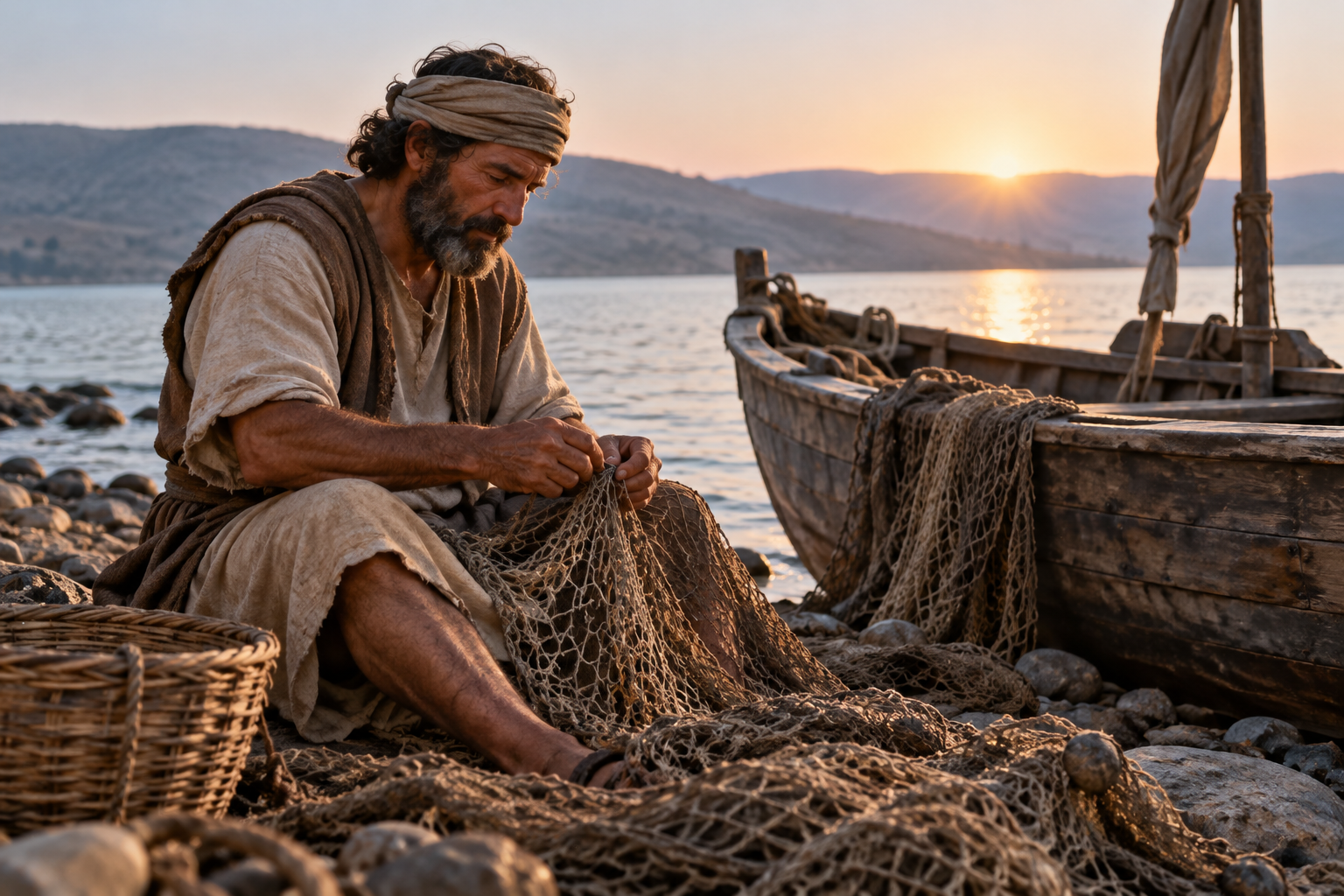
Peter knew how to be a fisherman. What would it mean to begin thinking like a shepherd?
The Shape of a Shepherd
Peter would have been familiar with Psalm 23. I wonder whether those words came to mind as Jesus spoke. Green pastures. Still waters. Restoring the soul. Paths of righteousness. The shepherd who walks with his sheep through dark valleys, protecting and comforting them.
There's much more to shepherding than making sure the sheep have enough to eat. He protects and corrects.
But something else occurs to me.
A shepherd doesn't personally feed every lamb. Mother sheep nourish and care for their young. The members of the flock have relationships of their own.
The shepherd watches over the whole flock, providing what it needs to flourish and intervening when it needs extra care.
His responsibility isn't to make every sheep dependent upon him. It's to help the flock thrive.
Perhaps that's an important distinction.
Jesus isn't simply asking Peter to become someone who does good things for other people. He may be inviting Peter to help cultivate a community in which people learn to care for one another.
And I wonder whether Jesus has just given him an example.
Come and Have Breakfast
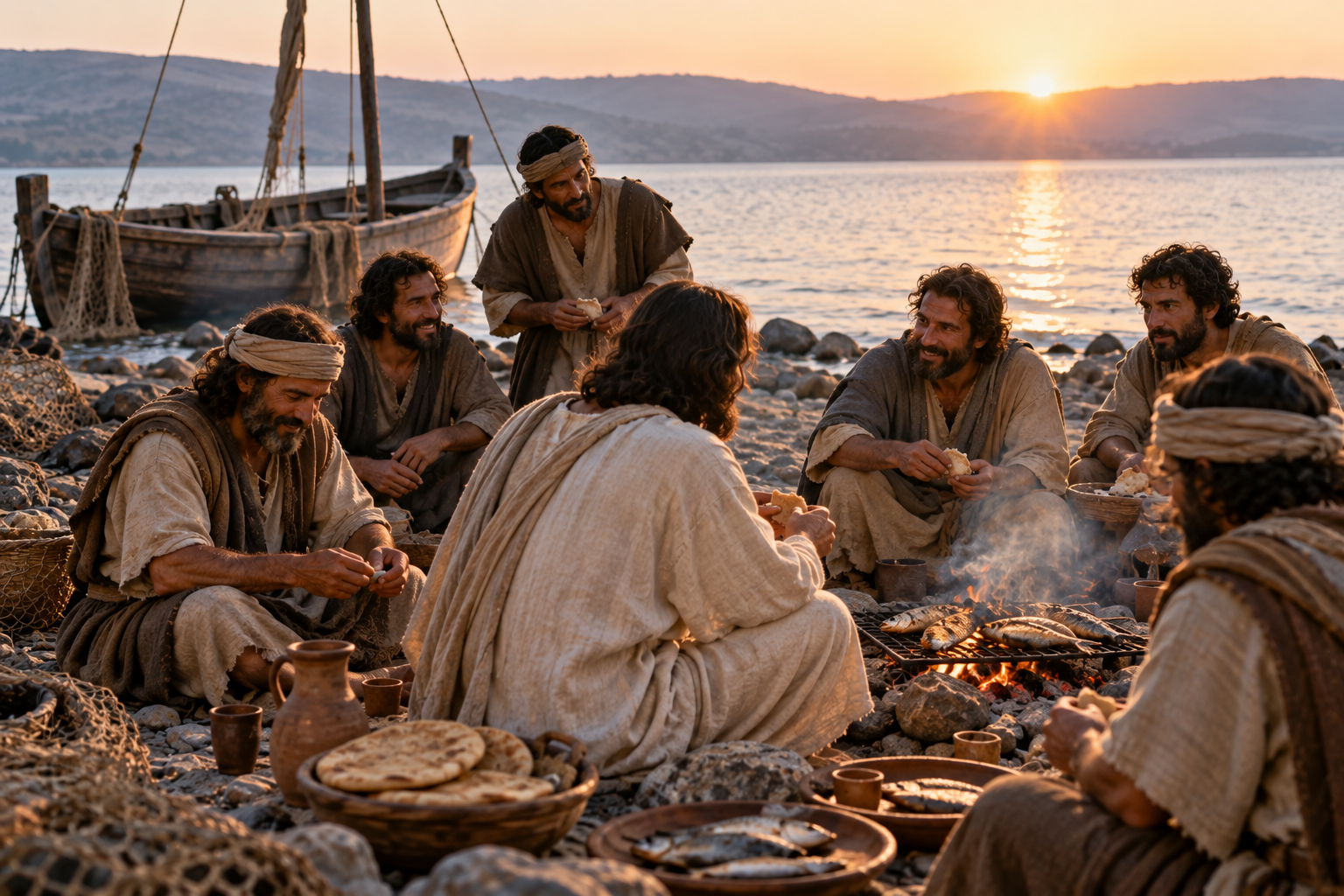
"Come and have breakfast." Jesus invites them into a shared morning beside the sea.
Think about what happened earlier that morning.
The disciples had been fishing all night without catching anything. From the shore, Jesus told them where to cast their net. Suddenly, they had more fish than they could manage.
Jesus could have stopped there. Their nets were full. Problem solved.
But when they reached the shore in that cool early morning hour, Jesus had already prepared a charcoal fire, with fish and bread waiting.
"Come and have breakfast."
I noticed that Jesus doesn't simply hand them something to eat and send them on their way. He invites them to gather around a fire - with him.
Maybe he wants us to imagine ourselves sitting beside that fire, watching Peter listen to Jesus.
These men had followed Jesus for years. They'd traveled together, disagreed, misunderstood one another, and shared experiences that must have bound them together in ways I can't imagine.
Now, after everything that has happened, they're together again.
Could they be thinking of another meal, just days earlier, when Jesus gathered them around a table? Remember, that evening he washed their feet and told them to love one another.
Now they're gathered for breakfast, and Jesus asks Peter to see himself as a shepherd, to view the world with a shepherd's eyes, and to tend his sheep.
I'm beginning to see a pattern.
Jesus doesn't simply provide for people. He brings them together. He participates in their lives, attends to their needs, and shows them how to care for one another.
Perhaps tending the flock means helping create the conditions in which people recognize that they belong to one another.
A Sheep Before a Shepherd
Throughout John's story, Peter has been a man of action.
He speaks boldly, makes promises, resists having his feet washed, and draws his sword when Jesus is arrested. When he recognizes Jesus standing on the shore, he jumps into the water rather than wait for the boat.
I like Peter.
Something about his enthusiasm, courage, and willingness to act is appealing. But perhaps those same qualities sometimes prevented him from seeing what Jesus was trying to show him.
Peter seemed ready to do something great for Jesus.
Was Jesus showing him another way?
Perhaps Peter didn't need less courage or enthusiasm but a different understanding of how to use them.
This made me stop and catch my breath. Jesus wasn't asking Peter to stop being Peter. He was inviting him to see what Peter could become.
A man whose courage would protect rather than control. Whose strength would serve rather than dominate. Whose enthusiasm would help others flourish.
I love the way Jesus gives him this responsibility.
He doesn't say, "Feed your sheep."
He says, "Feed my sheep."
Peter is being entrusted with responsibility, but not ownership.
I wonder how often caring for someone becomes an excuse for controlling them, directing their decisions rather than helping them grow.
But Peter isn't being given ownership of the flock. And he must remember something else. He's still a sheep himself.
This is a beautiful picture. The person entrusted with caring for others must help them grow into the people they're capable of becoming. To do so, he must keep listening for guidance, stay willing to learn, change direction, and recognize he doesn't have all the answers.
And perhaps that requires enough humility to recognize that the shepherd also needs the flock.
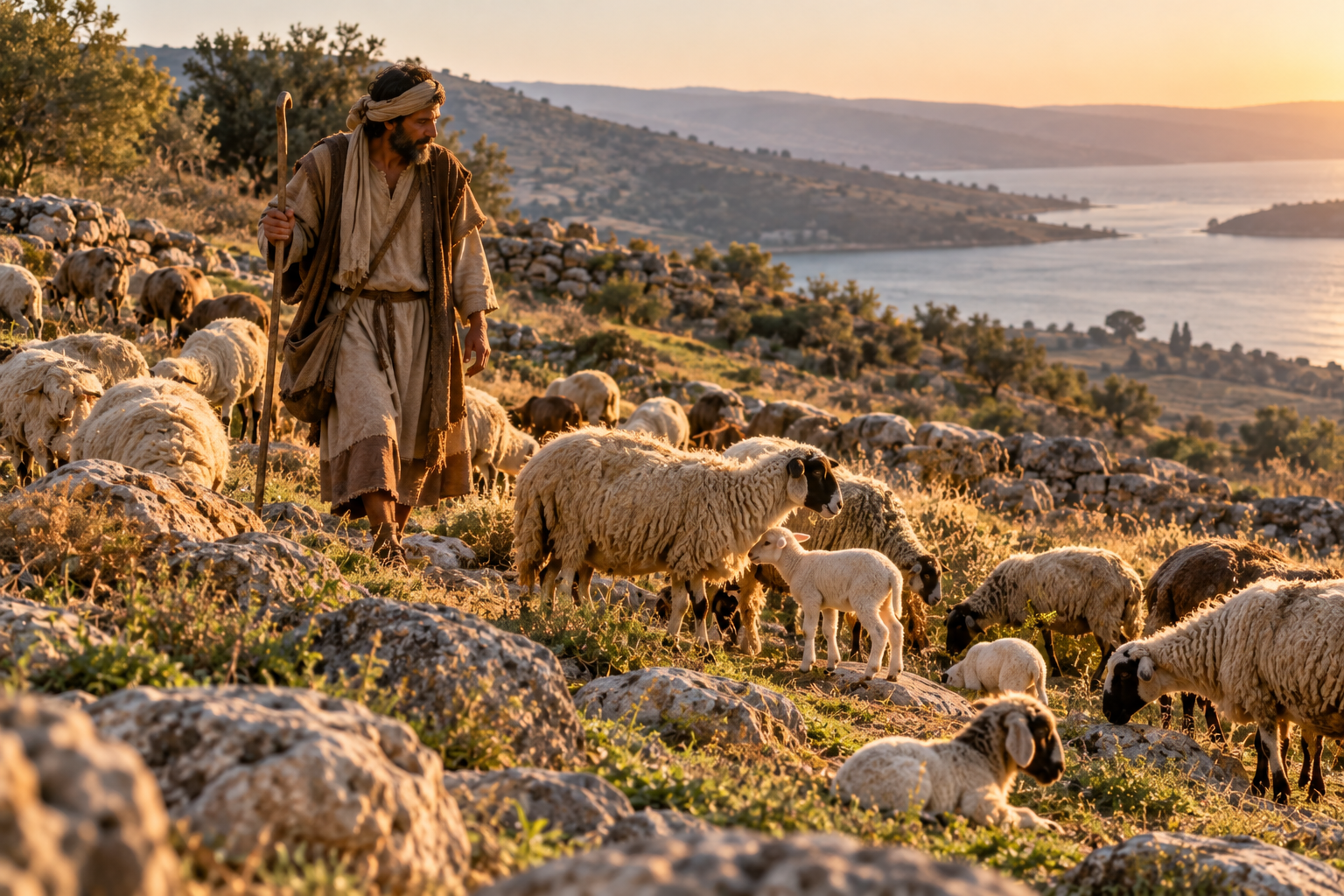
Tending a flock means more than meeting individual needs. It means caring for the life they share.
Follow Me
Then Jesus says something I didn’t expect.
He tells Peter that when he was young, he dressed himself and went wherever he wished. But when he grows old, someone else will dress him and take him where he does not want to go.
John says that Jesus was indicating the kind of death by which Peter would glorify God. But I wonder why John includes that prediction here, in the middle of this beautiful conversation about tending sheep.
But I do remember that at the Last Supper, Peter had asked Jesus where he was going. Jesus told him he couldn't follow now, but would later.
Peter objected.
"Lord, why can I not follow you now? I will lay down my life for you."
Now, Jesus has given Peter something to do with that love.
Feed my sheep. Tend my sheep.
And then, perhaps knowing where Peter's life will eventually lead, Jesus looks him in the eye and says, "Follow me."
Now Jesus gives him a responsibility that will occupy the rest of his life.
Care for my sheep. Remain attentive to their needs. Help them flourish. And continue following, even when the path becomes difficult.
By the time he writes this passage, John knows how Peter's story eventually ends. But predicting his death isn’t the whole story.
There is a lifetime of shepherding between this breakfast and that final day.
Perhaps Jesus isn't asking Peter to become preoccupied with some great sacrifice he might make in the future.
He's asking him to live faithfully today, without needing to control where that faithfulness will eventually lead.
And that helps me hear "Follow me" differently.
It's not a promise that life will always turn out as we wish. It's an invitation to remain faithful within whatever life brings.
Learning to See
I've spent several years studying John's Gospel, trying to understand what Jesus believed, taught, and demonstrated about life.
I admire the Good Shepherd. But am I developing the eyes of a shepherd myself?
Lately, I've noticed a small change in the way I listen to people.
There was a time when I felt almost compelled to answer every question, correct any misunderstanding, or contribute something that showed what I knew. Today, I’m more interested in understanding the person across from me.
I don't always succeed, but I wonder whether this is one small example of learning to see differently.
Maybe caring for someone begins with seeing them clearly.
Don’t get me wrong, I’m still largely self-centered. I still make plans and organize my days around what matters to me. But I'm learning to keep "one ear open" to needs I didn't anticipate.
And sometimes the most important thing I can do is recognize that someone needs my attention more than my advice.
But I'm also beginning to see that shepherding isn't simply about what I can do for someone else. It's recognizing that I need other people, too.
Our lives are connected. We are interdependent. We may become more self-sufficient, but we never become self-sustaining.
Is life meant to be an exercise in interdependence, even when we imagine we're living independently?
Perhaps the community Jesus envisions isn't divided into those who give and those who receive. We all do both, often without realizing it.
And God is present in the midst of those relationships.
Around the Fire
John could have ended his Gospel with chapter 20.
He had already explained that he wrote so we might believe Jesus is the Christ, the Son of God, and that through believing we might have life in his name.
Yet he gives us one more chapter.
A boat. A net full of fish. A charcoal fire. Breakfast with friends. A conversation between Jesus and Peter.
Perhaps John wants us to do more than understand what happened that morning.
Maybe he wants us to imagine ourselves sitting beside that fire, smelling the smoke, hearing the water moving against the shore, and seeing Peter listen to Jesus.
And I wonder whether John wants me to hear those words, too.
"Feed my sheep."
"Follow me."
Jesus doesn't give Peter a detailed plan - but an image to live into.
A shepherd who knows his sheep, recognizes their needs, and cares about their well-being.
A shepherd who understands that, in a community, lives are connected, and care flows in more than one direction.
And a shepherd who never forgets that he's a sheep himself.
The thought comes to me, “When I look at the people around me, what do I see?”
Do I see interruptions to my plans, problems to solve, and responsibilities to manage?
Or am I learning to recognize people whose lives are connected to mine, people entrusted, in some measure, to my care, just as I have been entrusted to theirs?
I wonder whether that's the vision Jesus was inviting Peter to discover beside the charcoal fire.
And I wonder whether, years later, Peter ever found himself tending someone in need and remembered that morning beside the sea.
The smell of the smoke. The warmth of the fire. The familiar faces gathered around breakfast.
And the voice of the Good Shepherd, still inviting him to follow.
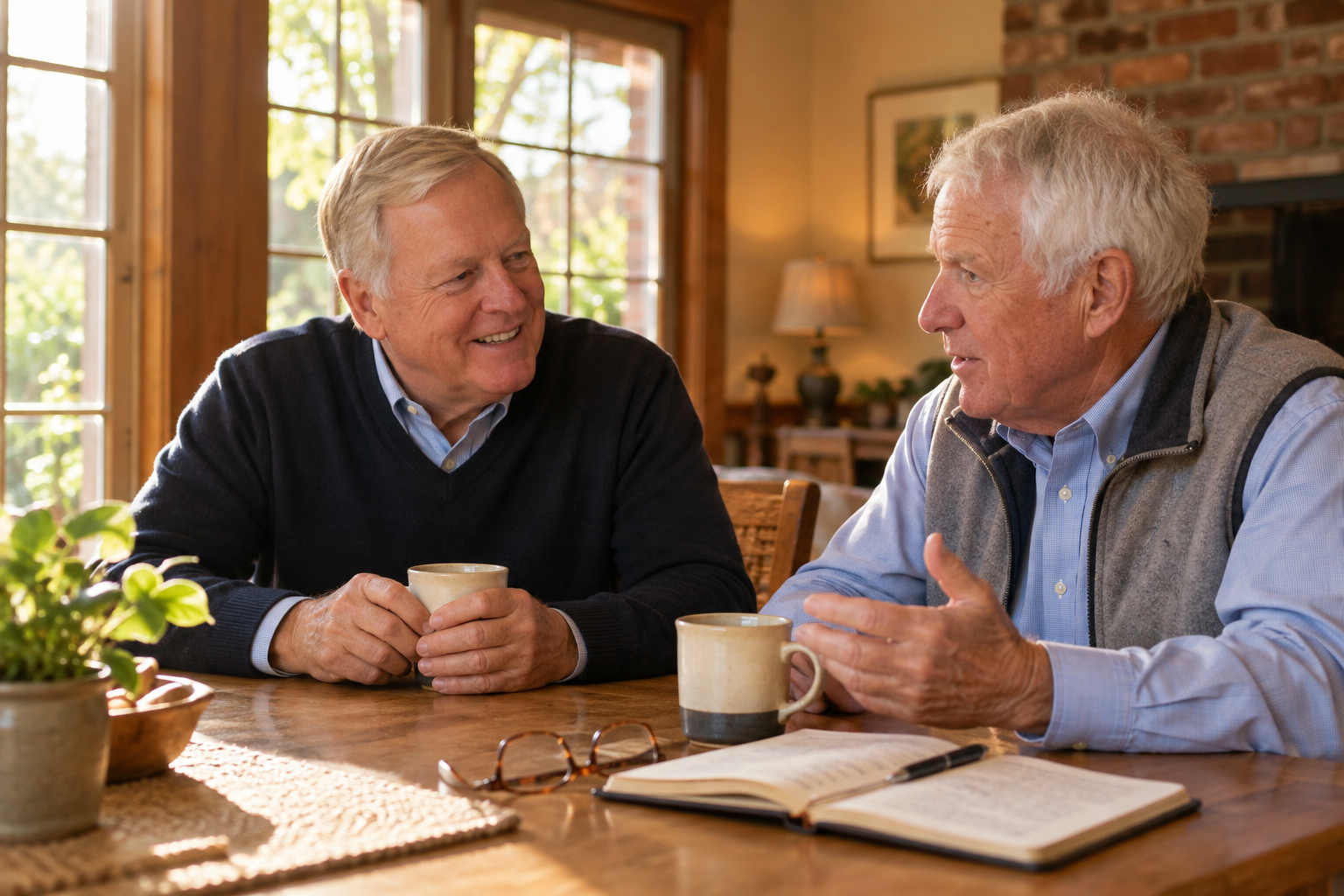
Sometimes tending begins with listening.
Maybe learning to see like a shepherd begins with noticing who's already sitting across from me.
