
John 20.5: Where Belief Becomes Trust
The Other Verse
John's last words stayed with me for days.
"That puts you at a crossroads where the next verse connects."
By "the next verse," I knew he meant the other of the two verses that had emerged from the chapter, so I turned back to the final verse of chapter 20, to the words John had penned nearly two thousand years ago.
"But these are written so that you may continue to believe that Jesus is the Messiah, the Son of God, and that through believing you may have life in his name."
I had read those words hundreds of times. At first glance, they seemed perfectly straightforward. Believe. Receive eternal life. End of discussion.
But after spending time sitting with verse 17, I wasn't so sure anymore. John had taught me to slow down.
Not to solve.
To see.
About then, my imagination took over again, and John was sitting beside me with a question in his eyes.
"If I believe in Jesus, then I get to go to heaven," was all I could come up with in the moment.
Almost as if he were afraid to push me too far, too quickly, he looked back at the painting on the wall. "What if that's not exactly what I meant?"
I studied the wall, too, trying to come up with an answer. I could almost see his words rising from the image: "My Father and your Father..." and "Through believing you may have life in his name."
While I watched those words take shape, he drew a long breath, closed his dark eyes, leaned his head slightly to the right, and smiled as though he were watching something I couldn't yet see.
I shifted in my seat and waited.
His eyes sprang open.
Life as It Was Meant to Be Lived
"He had a life in Him," John said softly. "A life that shone like a light. It gave Him energy. It shaped His decisions. We could see it in everything He did. He showed each of us what it means to be fully human."
I wanted to ask a question, but there was no room.
Still gazing at the wall, he continued. "I would watch Him and think, 'If God were here, He would be doing exactly this: helping, healing, forgiving, feeding.' It was life as it was meant to be lived."
Then it hit me.
"In Him was life..."
John had written those words at the beginning of his story. Life had been the thread running through the entire Gospel, only described in different ways. Living water. Bread of life. Resurrection and the life. Abundant life.
Suddenly, I began to wonder if I had misunderstood the whole point.
Maybe John wasn't primarily trying to explain how to get into heaven.
Maybe he was trying to explain what real life actually is.
I thought about my own life. Too often, it seemed shallow, lived on the surface, carried along by circumstances and emotions instead of something deeper. I found myself fidgeting.
"Life in His name," I repeated quietly. "His life. Life as it was intended to be."
Then the question escaped before I could stop it.
"Why hadn't I seen it before? Not afterlife...life."
John smiled and made a small check mark in the air with his finger.
A Deeply Human Life
His eyes settled on one particular scene, a woman beside a well.
"You know," he said, "we never saw Him humiliate a person into changing. Their lives were changed without that."
Then his gaze shifted.
"He lived without our rules about who's important and who's not, who's in and who's out. With Him, everyone was welcome."
Was he looking at the Samaritan woman?
Now his attention moved toward the lame man beside the pool.
"Life where we learn to master our desires instead of letting them master us."
Another scene seemed to grab his attention: Jesus standing before Pilate. "A life of peace without the need for power. He didn't need to win. He simply loved."
This time he pointed. It was to the scene of Jesus kneeling with a towel around His waist. After a long, slow exhale, John whispered, "A life of giving before getting. He was always giving."
"A deep life," I said.
"A deeply human life," he corrected. "An abundant life."
"I think I'm beginning to get it."
His eyes narrowed, and both hands rose in surrender.
"We thought we did, too. It was only after He left us that we began to see it isn't something you get. It's something that gets you."
The Next Step
"But you said, 'Believe,'" I pushed back. "And I do. I agree that's the way we should live."
John stood and cupped his hand behind one ear.
"You're hearing your word, not mine. My 'believe' doesn't stop with agreement. It takes the next step into trust."
Then he took one large step.
"Believe."
On the next step, as his foot settled onto the floor, he said, "Trust."
He slowly turned back toward me, then laced his fingers together in a gesture that needed no explanation.
You can't have one without the other.
"Trust is what belief looks like when it becomes real."
In those two simple steps, John helped me see that I still didn't fully understand.
Then, almost smiling as he looked out the window, he asked a question that changed everything.
"Alan...tell me something."
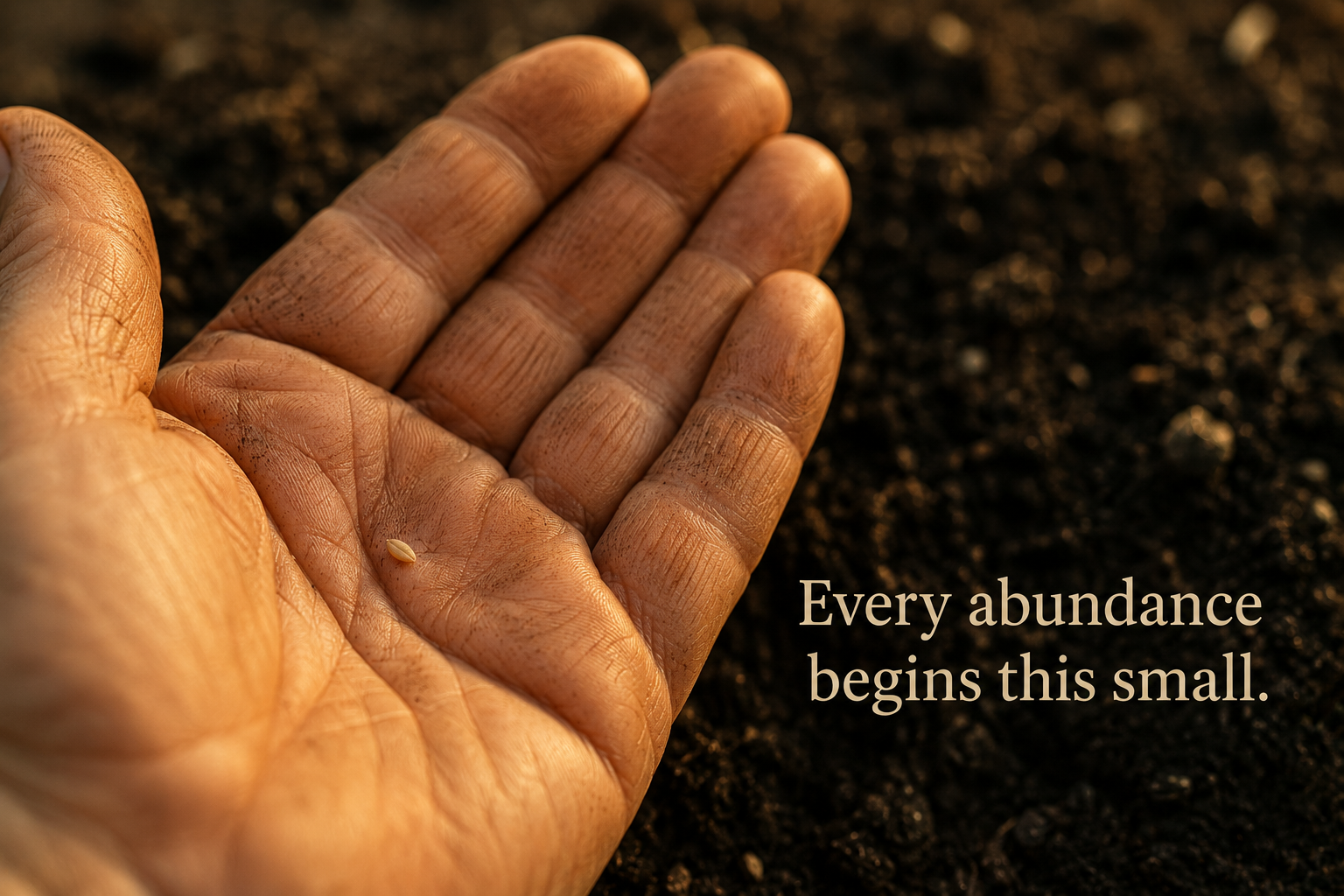
"If I handed you a tiny tomato seed and told you that one day it would produce hundreds of tomatoes, would you believe me?"
I nodded.
Everything about him, his eyes, his posture, his gentle confidence, suggested this was one of his favorite things to do: explain spiritual realities through ordinary life. I was beginning to understand why so many people admired and followed him.
What Happens After You Plant
"When you put that tomato seedling into the black dirt," he asked, "what's in the back of your mind?"
"A big, juicy tomato."
Now I was smiling.
"You believe the plant is going to grow and produce that tomato."
"You bet."
"So you plant."
I nodded.
"Then you simply walk away and come back two months later?"
"I wish."
Already knowing the answer, he asked, "What happens during those two months?"
I took the bait.
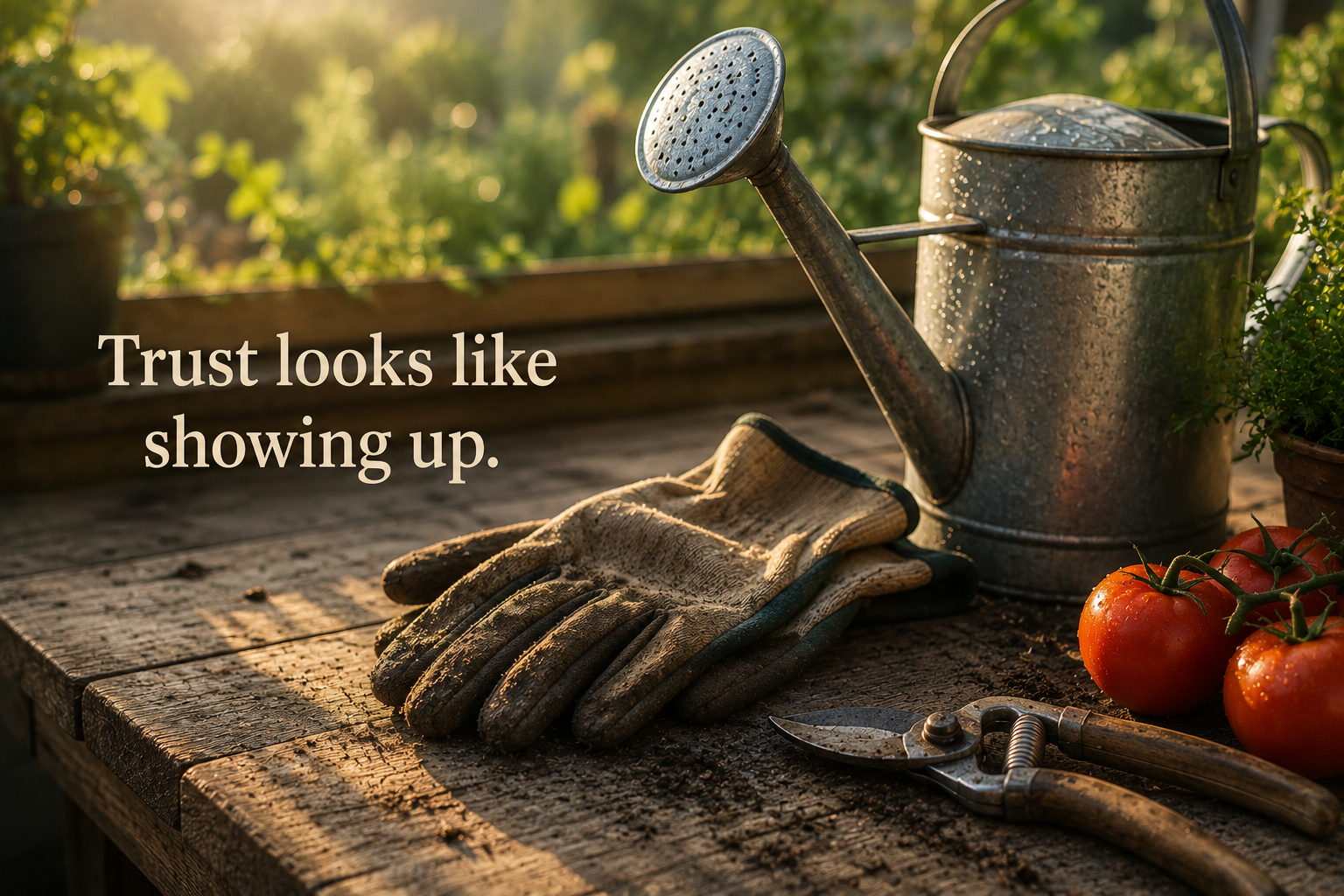
"I water."
One finger.
"I weed."
A second.
"I mulch."
A third.
"I fertilize."
A fourth.
"I chase the bugs and deer away."
My thumb completed the hand.
"Well done," he laughed.
He's got me now, I thought.
"You plant because you believe. You water, weed, and mulch because you..."
"Trust," I interrupted before he could finish. "Without the trusting steps, nothing grows. Or, at best, it's a gamble."
My hand rolled imaginary dice across the desk and added, "It may. It may not."
As he grinned and scooped up the imaginary dice, he asked, "Can you give it back to me in one sentence?"
I stood and took one exaggerated step.
"Believing causes me to plant."
Then another.
"Trusting causes me to water, weed, mulch..."
He winked a wrinkled eye, "That's two sentences, you know."
A pause.
"But you're getting there."
Two Words Appear
Silence followed.
A long silence.
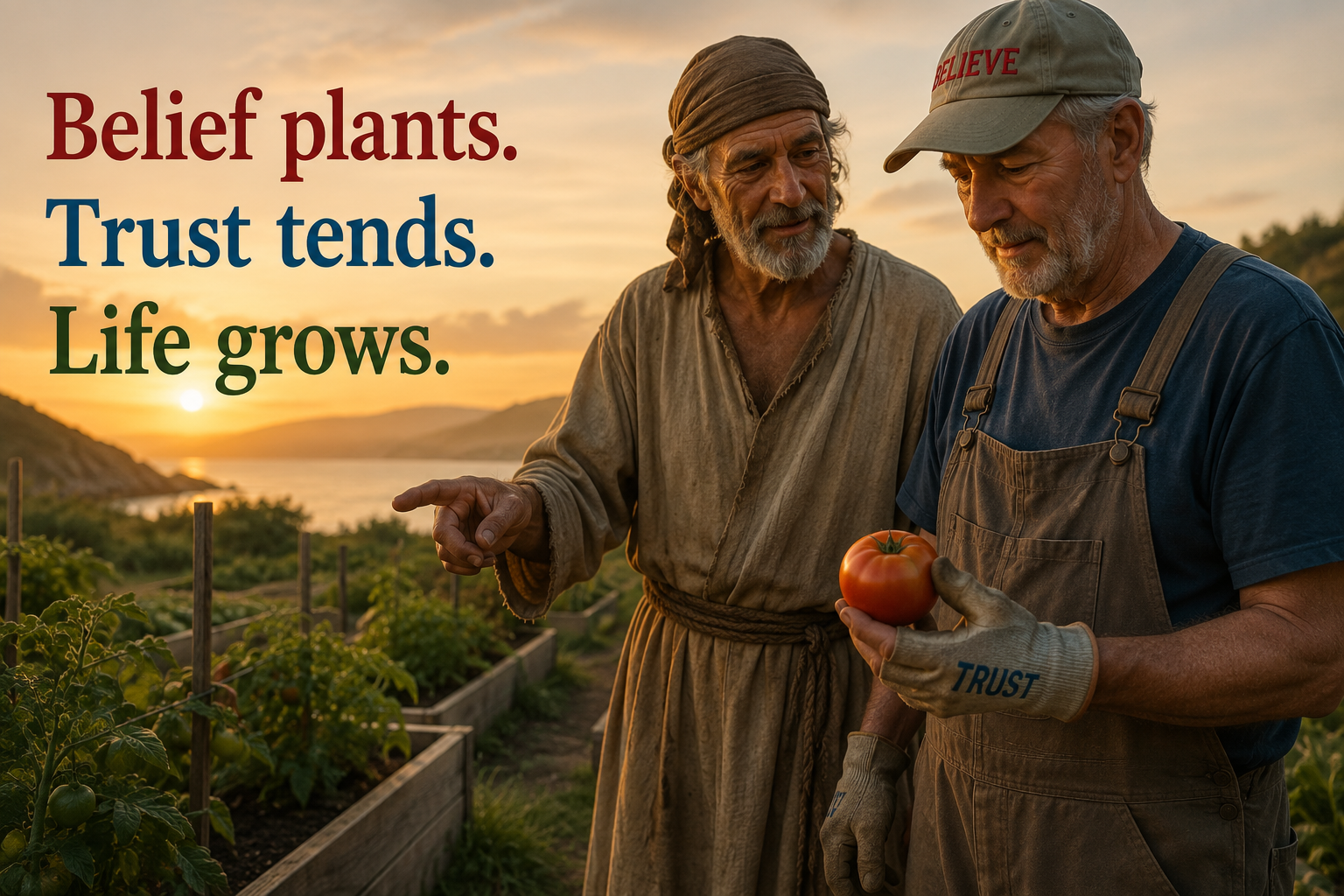
Together, we looked out the window toward the garden. In my illusion, I watched myself walking between the raised beds, pulling weeds, adding water, and checking vines. I watched for what felt like a long time before I noticed something written on my cap.
As I reached for a tomato just beginning to blush, I noticed something else.
There were words on my gardening gloves.
John must have seen them, too, because we both leaned closer to the window.
Across my sweat-stained cap, in bright red letters, was one word.
Believe.
Across my worn gloves, in bright blue letters, another.
Trust.
We looked at each other in a moment of deep recognition.
Then it settled over me.
Trust doesn't simply produce the watering and weeding.
Trust is the watering and weeding.
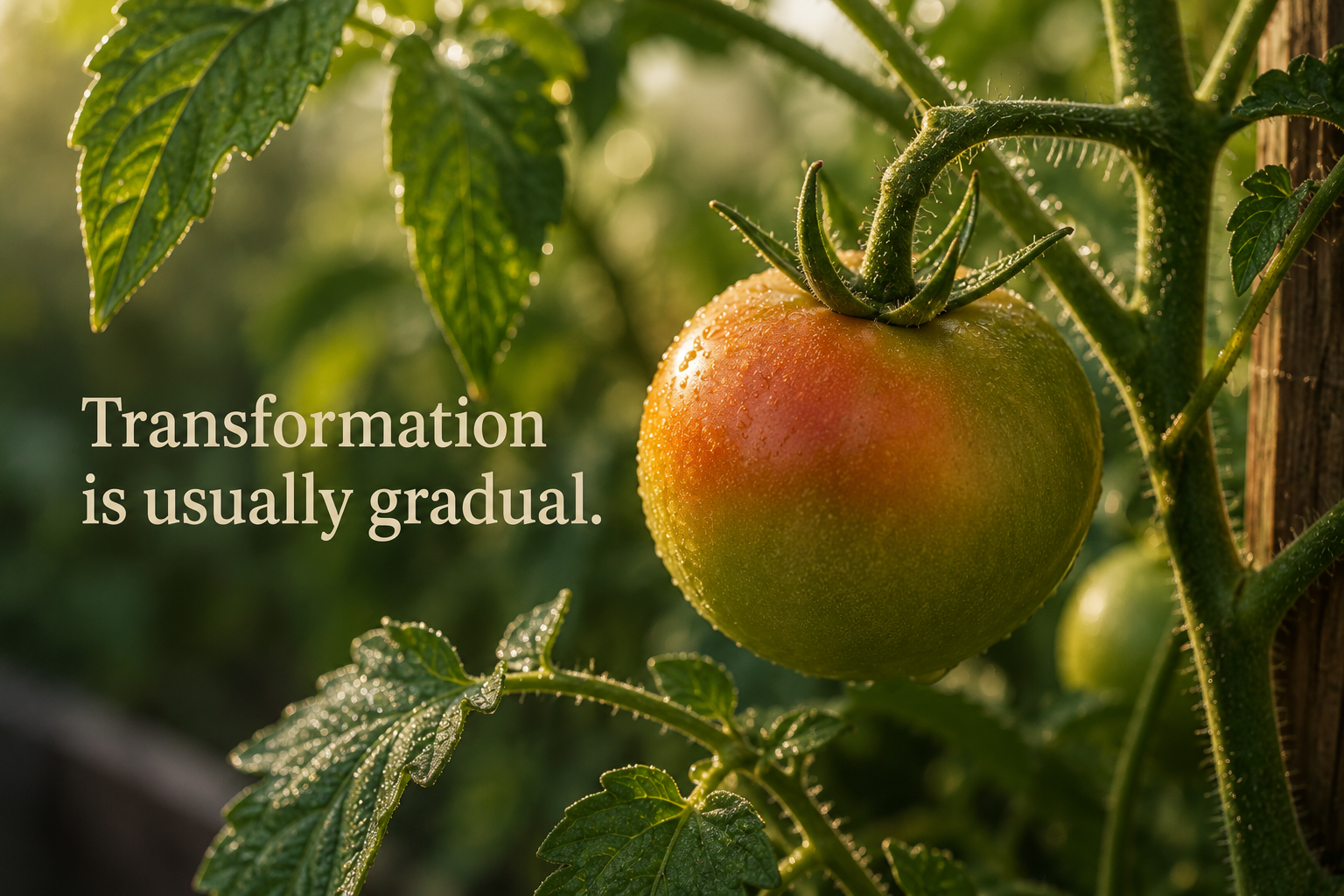
John held out his hand.
"If you want this tomato, you must plant and tend."
I smiled and added.
"Believe and trust."
Life Grows
Just as I thought we were finished for the day, something drew my attention back to the wall. I turned in my chair and quietly watched.
It only took a moment before I saw it emerging between the scenes.
Jesus going beneath the water.
Jesus walking upon the water.
Jesus forgiving.
Accepting.
Feeding.
Healing.
I said it before I thought it, “Jesus trusting.”
John smiled.
I smiled, too.
Looking back toward the garden, then down once more at verse 31, I found myself thinking:
Belief plants.
Trust tends.
Life grows.
To my grandchildren and their children,
There have been seasons when I thought believing was mostly about agreeing with ideas. The older I've become, the more I've discovered that belief is only the beginning.
Every spring I press tiny seeds into dark soil. I don't do it because I know exactly what will happen. I do it because I've learned to trust the One who built life into the seed.
My hope for you isn't simply that you'll believe good things. I hope you'll trust them enough to take the next step. Sometimes that step will feel small. Sometimes it will feel risky. But almost everything worthwhile in life begins with taking it.
